
Review
WATCHMEN: A Thought-Provoking TV Masterpiece
Watchmen series is extraordinarily intelligent, exquisitely executed entertainment that creatively develops its comic-book source to tell its own story.


Let us talk about the Watchmen.
Who will watch the Watchmen themselves?

The fate of Alan Moore’s Watchmen (script) and Dave Gibbons’s Watchmen (art) is actually two stories in one. One is the story of a great triumph: the twelve-chapter masterpiece created in the 1980s, a multilayered, intelligent, painstakingly planned portrait of Western society and a bitter reckoning with the American dream.
Watchmen are regarded as a leading achievement of the genre, and it is the only comic to appear on Time magazine’s prestigious list of the 100 greatest books of the twentieth century.
The other is the story of a greedy corporation and an open conflict with Alan Moore, the father of Watchmen. When Moore signed his contract with DC Comics, he agreed to publish his work for them on the condition that the rights to the series and its characters would revert to him once the comic’s print run sold out. DC, however, has to this day refused to allow the print run ever to sell out and does with Moore’s creation whatever it pleases.

In this way, we have seen a divisive film adaptation directed by Zack Snyder, a disastrous computer game serving as the film’s prequel, a horribly received comic-book series meant to introduce readers to the main comic Before Watchmen, and now the entirely misguided comic-book crossover with characters from DC’s main universe entitled Doomsday Clock, in which Rorschach, Doctor Manhattan, and others meet, among others, Batman and Superman, and so on.
Damon Lindelof—creator of Lost and The Leftovers, and privately a great fan of Moore’s comic—on the one hand reportedly dreamed for a very long time of creating a series, and on the other hand made Warner Bros. (which owns both DC Comics and HBO) wait equally long before agreeing to produce it. Ultimately, as we know, the parties reached an agreement, and Lindelof thus united the two stories of the Watchmen. He naturally inserted himself into the corporate conflict with Moore (who does not even appear in the series credits and who also placed a curse on its creators), but he also—like Moore and Gibbons over thirty years ago—achieved absolute triumph.
He created a masterpiece that perfectly continues the original monument.

Nothing ever ends
Damon Lindelof has created a completely unprecedented series. It is not a screen adaptation of the comic but a kind of continuation of Alan Moore’s original work. It completely ignores the comic parasites (Before Watchmen and Doomsday Clock) and also radically distances itself from Snyder’s film (for those who have not read the comic: the film is a fairly faithful adaptation but entirely changes the comic’s ending).
Of course, that does not mean that for viewers who have not read the comic the series will be incomprehensible, but familiarity with the source material will certainly enhance one’s enjoyment of the viewing.

In one episode, during an FBI briefing, the famous Rorschach journal (which forms the comic’s narrative backbone) appears on a presentation slide. The agent leading the meeting begins to ask what it is doing there. It is not the 1980s, no one cares about Rorschach he says. The writer perfectly captures the essence of the series, which approaches its source material with respect and visible love, yet is far from merely reproducing it on screen.
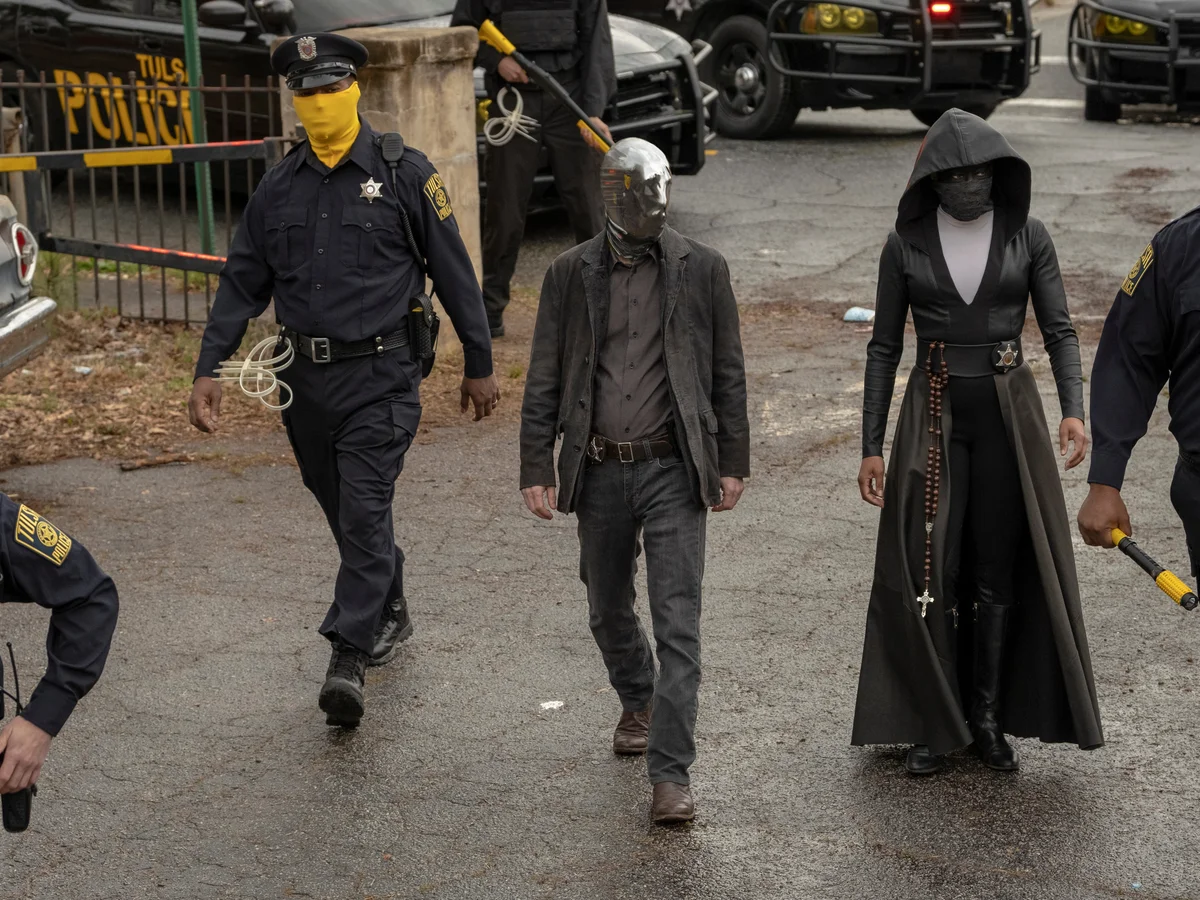
So what will we find in the series? The main plot takes place thirty years after the comic’s finale and presents an alternate world in which the United States have been governed for decades by the extremely liberal President Redford. In American Tulsa, following a massacre of police officers carried out by right-wing extremists and in order to protect the remaining officers and new recruits, the unit was transformed into a group of masked and anonymous superheroes.
The tense situation in the city escalates when the police chief is murdered, and characters from former years begin to become involved in the events.

What happened to the American dream?
To the great surprise of many, the primary focus of the writers is the issue of America’s racial problems. The creators analyze the issues of past years in great depth (drawing on characters and historical events—in fact, many viewers learned of the Tulsa massacre only through HBO’s production), and in the series’ present-day fictional America they reflect current tensions and divisions and demonstrate that even with the end of segregation and the social revolution of the mid-twentieth century, racial prejudice did not magically disappear.
In the seventh episode of the series we can hear a white supremacist explaining his actions: The scales have tipped, and today it is difficult to be white in America.
.
However, in Watchmen racism is not merely a fashionable or convenient topic (as right-wing internet users might wish), but a springboard for more universal reflections—does being rooted in the past prevent us from moving into the future? Can pain be inherited? Are traumas and prejudices encoded in human DNA? How can we come to terms with a legacy that is inseparably linked to hatred? Do we have the right to be proud of our parents’ sins or the duty to be ashamed of them?
And all of this is set in the world known from the original comic, built on recurring patterns and repeated (but not reproduced!) motifs.
For if the comic begins with a murder, then the series does too, though with a completely different one. If in the original Jon had grown tired of humanity, why in the series would his former partner not say that she is tired of all this foolishness? Damon Lindelof plays with the comic, creatively interprets it, and refers back to its essence. He never loses the purely entertaining quality—after all, Watchmen is an action-packed crime drama.

This country has had enough of damned fireworks
Fortunately, the level of Damon Lindelof’s and company’s writing perfectly matches the production standards of the series. It is undoubtedly top-tier television, featuring excellent cinematography, outstanding sets, eye-pleasing costumes, and—perhaps above all—superb music by Trent Reznor and Atticus Ross (known, among other collaborations, for their work with David Fincher). The creators are not afraid to play with form. Special recognition is due, for example, to the fifth episode—entirely focused on the origin story of one character, shot in black and white and styled as a single, uninterrupted take.

It is worth adding that much of the story and world-building takes place in the background or even tertiary plane.
Under Lindelof’s watchful eye, the creators slip into nearly every scene more or less visible details: references, easter eggs, elements of foreshadowing. It is a true feast for fans of such devices, which themselves refer back to Moore’s comic, likewise riddled with intertextual allusions.
Watchmen also boasts an excellent cast. It is absolutely difficult to point out any weak link among the actors, but it is easy to identify the biggest stars of the production. The main female character herself is rather a common point for the parallel storylines of other figures, which makes her perhaps the least interesting of the characters vying for a leading role, but thanks to the excellent Regina King it is hard to feel even a moment’s boredom in following her fate.

Undoubtedly the most compelling performances come from the ever-reliable (and superbly written) Jean Smart and the fabulously reveling Jeremy Irons in his absurdly constructed subplot. Attention should also be paid to the distinctive Don Johnson in his relatively small but crucial role and the superbly ambiguous Tim Blake Nelson.
Thermodynamic miracle

Thermodynamic miracles…. explains Doctor Manhattan to his beloved Laurie in the original comic, events of such infinitesimal probability as to be virtually impossible. The phrase is also referenced in the series by Agent Blake, and I cannot help but use it to describe Damon Lindelof’s series.
When it was announced that work was underway on a television incarnation of the Watchmen, I merely shrugged. I saw no need for another confrontation with Alan Moore’s masterpiece. I did not at all expect that we would receive a work that expands on the original, creatively corresponds with it, yet—with full respect—dares to move forward so as to stand as an autonomous piece.
Watchmen is extraordinarily intelligent, exquisitely executed entertainment that creatively develops its comic-book source to tell its own story and present a thought-provoking portrait of twenty-first-century Western society.
At this time no decision has been made regarding production of a second season. Damon Lindelof believes we should not treat the first season’s finale as a cliffhanger.


LUCIA’S GRACE. Resembles a Kind Of Missionary Endeavor

DOKUMENT. Short Film That Feels Monumental

BEAUTIFUL BOY. The Acting is Remarkable [REVIEW]

Looking Back at SPIDER: More Terrifying Than Horror
