
Review
EXIT THROUGH THE GIFT SHOP. Banksy Avoids the Spotlight
Exit Through the Gift Shop therefore has little in common with a documentary about a mysterious, anarchist artist.


Going to see Exit Through the Gift Shop some time after its release, I did not have a clear sense of what the film would actually be about. I expected a documentary on street art—something that, truth be told, does not particularly fall within my personal interests. What I ended up seeing, however, far exceeded those expectations. For the first time in quite a while, I watched a film that offered me both genuine entertainment and thoughtful reflection at once, and one I can recommend with a clear conscience even to people who would not consider themselves fans of street art.
Banksy—the creator of the documentary—is by now a legendary representative of so-called “guerrilla graffiti.” He is a figure whose identity is carefully guarded, a character as fascinating as he is controversial. To some, he is a genius, a faceless icon, a contemporary Superman who, under the cover of night, tries to fix the world; to others, merely a vandal polluting urban space. Numerous myths and urban legends have grown up around him. Some claim to have seen him, others even impersonate the artist; there are alternative biographies circulating, while conspiracy theorists insist that he is backed by an organized group and that Banksy himself is an artificially constructed entity designed to stimulate the collective imagination.
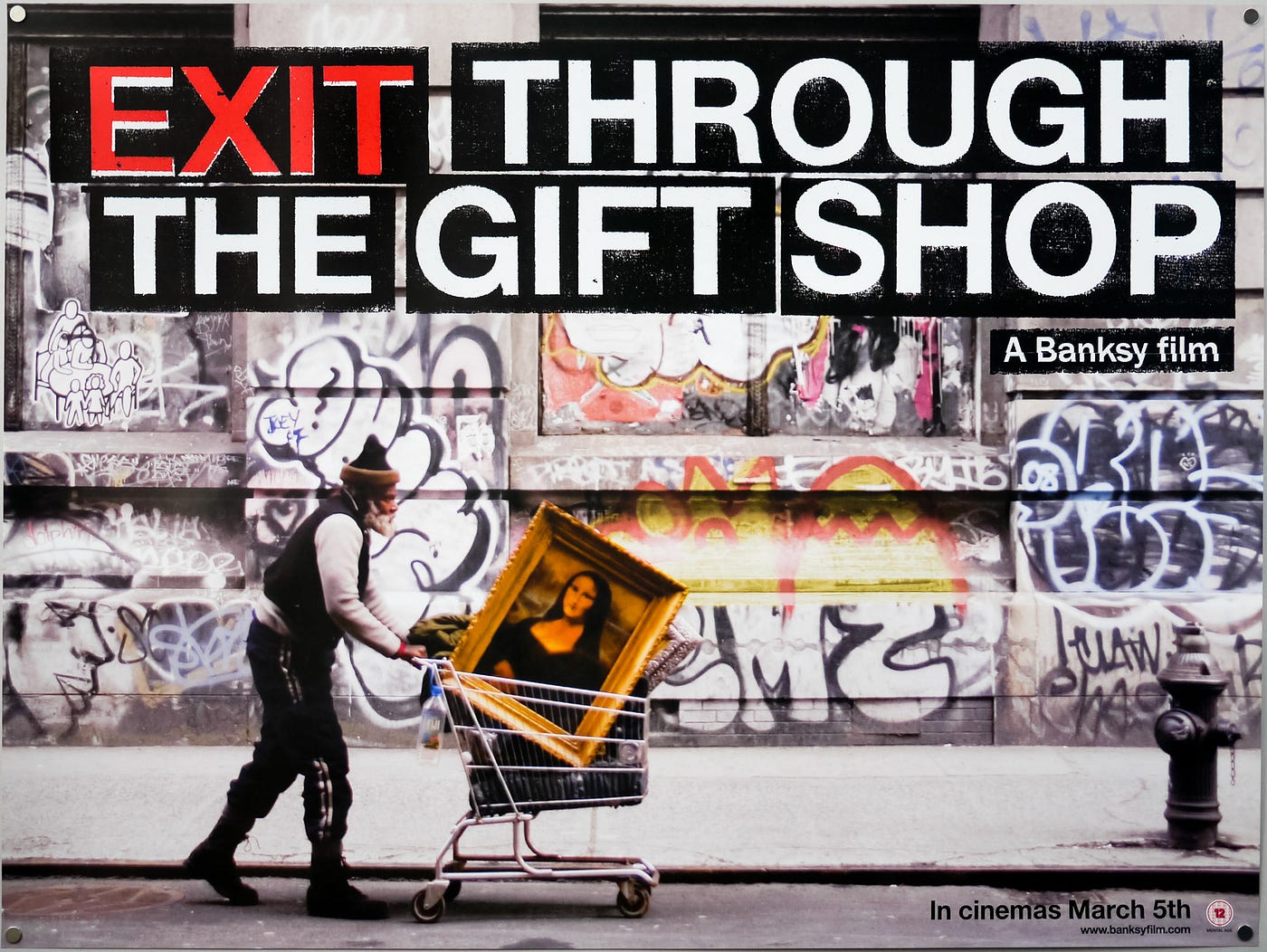
There is therefore no doubt that Banksy, with all this mythic and quasi-fantastical aura surrounding him, is perfect material for a documentary. He himself—and the phenomenon of street art (with a capital “S,” of course)—would be more than enough to build an engaging story about the boundaries of art and about a nonconformist who, for years, has surprised the public with his inventive and subversive activities. Yet the filmmaker goes two steps further. The documentary, initially intended to focus on the artist, perversely transforms into the story of a self-taught documentarian—a maniac of sorts—who stores kilometers of videotape in his home, recording the tiniest details of his (otherwise rather unremarkable) life, while nurturing ambitions of making a monumental film about Banksy.
Before long, we begin to wonder whether the documentary is, in fact, a documentary at all, and it becomes increasingly difficult to determine what in the film is truth and what is fiction. What we are left with, it seems, is yet another masterful provocation authored by Banksy.

This quasi-documentary fits perfectly into the artist’s broader body of work. It is both a joke and a manifesto, a combination that appears to be the hallmark of this street artist’s practice. Beneath a surface of mockery and acts that sometimes border on juvenile pranks (in addition to his street murals, the artist is also known for a series of performative happenings—one need only recall his infamous stunt of scattering counterfeit banknotes during the Notting Hill Carnival, or the doctored Paris Hilton CDs he secretly placed in shops, featuring a nude Hilton on the cover and song titles such as Why Am I Famous? and What Am I For?), Banksy strips his acts of sabotage of unnecessary pathos and grandiosity, smuggling in messages far more significant than the apparent weight of his jokes would suggest.
His work functions as an anti-capitalist protest (the fake banknotes), a mockery of show business (Hilton), an objection to consumerist lifestyles (the famous Show Me the Monet, referencing Monet’s Water Lilies but depicting shopping carts submerged in water), and even as politically charged art. Examples of the latter include his murals on the wall separating Israel and Palestine—such as a fragment resembling a postcard view of a holiday paradise—or the inflatable Guantánamo Bay prisoner that appeared for several hours in California’s Disneyland.
Not all of these examples appear in the film. And rightly so, because this is not, in fact, a film about Banksy. Its main subject is contemporary art—or rather the meager by-products that hide behind that label. Its essence is captured by the artist himself in a paraphrase of Churchill’s famous words: “Never in the field of human history has so much been used by so many to say so little.” The gallery of “modern art” created specifically for the film and run by the aforementioned camera-obsessed eccentric (in whom a calling to create art awakens alongside his cinematographic ambitions) is a collection of mutated works derived from the pop-art icon Andy Warhol. The grand opening of this monstrous creation turns out to be a spectacular success, complete with the appearance of several celebrities. We witness the naïveté and hypocrisy of people who “buy into” these caricatural works and marvel at their supposedly “interesting” character.
Exit Through the Gift Shop therefore has little in common with a documentary about a mysterious, anarchist artist—something its creator would likely never have allowed, seeing it as a narcissistic exercise. Banksy deliberately avoids the spotlight and retreats into the shadows, both literally and metaphorically, treating the film as yet another happening of which he is the author rather than the protagonist. And just like his urban, street-based work, the film continually surprises with its originality and sense of humor. It is light, amusing, and unpretentious. Its message is delivered without needless dogmatism, with a wink and a generous dose of humor—much like Banksy’s own art, which he approaches with self-irony, describing it as ugly, irresponsible, and childish (but only when done properly).


LUCIA’S GRACE. Resembles a Kind Of Missionary Endeavor

DOKUMENT. Short Film That Feels Monumental

BEAUTIFUL BOY. The Acting is Remarkable [REVIEW]

Looking Back at SPIDER: More Terrifying Than Horror
