
Review
CREEP. A killer who talks you to death [REVIEW]
In Creep we witness the triumph of spontaneity. While the filmmakers had a rough outline of a script, improvisation took over during the shooting.

![CREEP. A killer who talks you to death [REVIEW]](https://dev.filmfolly.com/wp-content/uploads/2025/09/CREEP.-A-killer-who-talks-you-to-death-REVIEW.webp "creep-5 | FilmFolly.com")
Found footage horror is one of my favorite variations of the genre. By using amateur tapes meant to create the illusion of a pseudo-documentary, the sense of fear feels particularly authentic. A complex plot isn’t even necessary, since tension arises naturally, almost on its own. Fear strikes at the most unexpected moment, right when the camera happens to catch it—sometimes almost by accident. Until recently, I thought little could still surprise me in this low-budget convention. But after watching Creep, created by Patrick Brice and Mark Duplass, I completely changed my mind. It turns out that the best recipe for good found footage is… no recipe at all.
In Creep we witness the triumph of spontaneity. While the filmmakers had a rough outline of a script they prepared together, improvisation took over during the shooting of individual scenes. The creators are also the only actors in the film, and while filming they let themselves go, giving each other freedom in dialogue and behavior. Interestingly, Creep was originally intended to be a dark comedy. Only after showing some of the scenes to friends did Brice and Duplass decide that the material leaned much more towards horror.
They finished the film in that spirit, though it still carries undertones of sharp, biting humor.

Although improvisation is evident, it never feels sloppy. The film is built on solid foundations and a clear framework that the filmmakers never abandon. Its greatest strength lies in its highly original plot, intriguing from the first to the very last minute. It starts out rather trivially, with a victim falling into a trap set by the predator. Aaron (Patrick Brice) is broke. While searching for work, he comes across a peculiar ad.
He decides to help Josef (Mark Duplass), who claims to be dying and wants to make a video diary—a keepsake for his unborn child, much like Michael Keaton in My Life.
Armed with a camera, Aaron spends the entire day with Josef, filming his daily activities and conversations. What he doesn’t know is that by accepting this bizarre job, he has essentially signed his own death warrant. How quickly will he realize the danger he’s in?

The best thing about Creep is that, like its protagonist, it’s completely unhinged. For most of its runtime, it carefully maintains the illusion of normality. Even though we sense where Aaron’s encounter with Josef might ultimately lead, there’s no way to predict the exact direction the filmmakers will take. We know the destination, but the unpredictable pulse of the film keeps us guessing about the path. The story is packed with Josef’s carefully concealed madness, brilliantly acted by Duplass. He refuses to reveal to either his victim or the audience just how deep his darkness runs, constantly manipulating our emotions.
A particularly eerie element is the wolf mask Josef keeps hidden in his closet. But again, appearances deceive—the film’s horror doesn’t rely on clichéd jump scares. To me, Creep terrifies most with the conclusion that falling into a killer’s trap is disturbingly easy when we allow it ourselves. Not brute strength, not weapons, but persuasion and cleverness can be a murderer’s most powerful tools. As Josef, Duplass masters this art of persuasion, toying with his victim, testing his tolerance for fear, and keeping up a friendly facade while playing a deadly game.
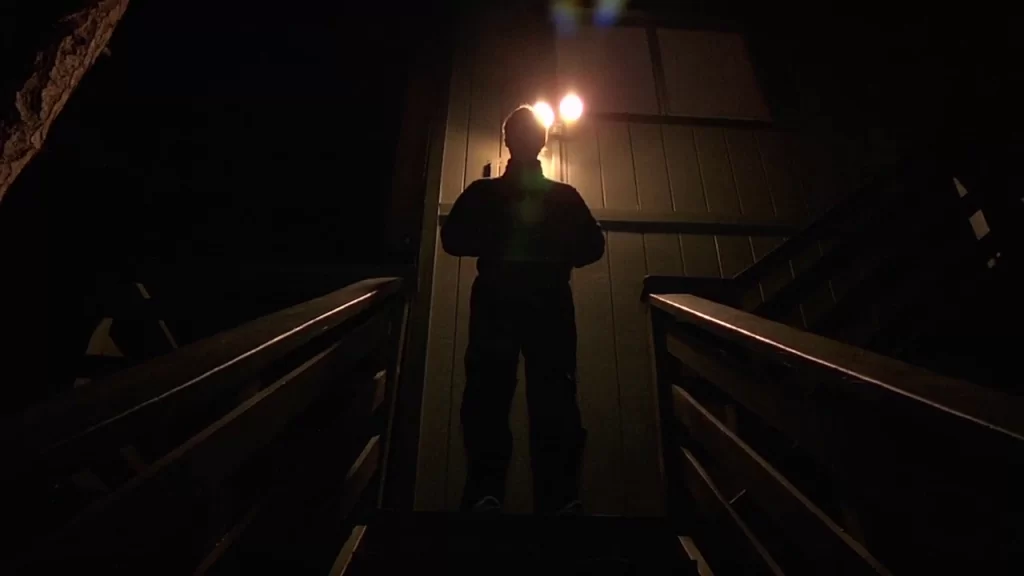
Aaron’s behavior—his trust and patience toward Josef—may seem naïve. Yet, on reflection, many of us might act similarly. Imagine meeting someone new, friendly, seemingly open, a blank page ready to be written on. Our opponent knows they’re a mystery to us, and so they can pretend to be anyone, to become who they want us to see. The key question is: what would such a person have to say or do for warning bells to ring in our heads? In Creep, Josef drops hints of madness but cleverly balances them with gestures of sincerity and friendliness, lulling both his victim and the audience into complacency.
This is the brilliance of this strange and unassuming film: it tells the story of a murderer who looks and sounds like someone you might meet on the street or in a grocery store. It portrays a madness so deeply hidden it mirrors the everyday anxieties we bury inside ourselves. From beginning to end, it persuades us that Josef’s intentions are pure, that he is incapable of harm. But the finale shatters that illusion, leaving us hollow, having just witnessed someone who seemed like an ally reveal his true face.
If you’d like proof of why I call Creep one of the best found footage horrors of recent years, I recommend checking out its sequel, released in 2017.
Both films are available on Netflix. The second part maintains the quality of the first but shifts the focus: this time it’s not Josef (who takes on the name Aaron) seemingly in control, but his new victim, an aspiring journalist and YouTuber named Sara. The positive reception of both films has led to a third installment, currently in production. Interestingly, Duplass has even expressed interest in making a prequel about Josef’s past.
Whatever else they create, it’s the original Creep from 2014 that will be remembered for bringing a fresh, unsettling dose of originality to an overused formula.


LUCIA’S GRACE. Resembles a Kind Of Missionary Endeavor

DOKUMENT. Short Film That Feels Monumental

BEAUTIFUL BOY. The Acting is Remarkable [REVIEW]

Looking Back at SPIDER: More Terrifying Than Horror
