
Article
I KNOW WHAT YOU DID LAST SUMMER: A Slasher with a Hook
I Know What You Did Last Summer became a solid hit ($125 million), helping to rejuvenate the very slasher genre Scream had so joyfully mocked.


There’s something strange about the fact that the slasher genre experienced a revival right after the release of Scream—a fully-fledged representative of this horror subgenre and, at the same time, one that brilliantly pointed out and mocked all its sins and conventions. The films that followed not only failed to reach Wes Craven’s mastery in building suspense and staging bloody scenes, but above all, they showed no interest in playing with a formula that had already burned out before the ’80s even reached their halfway point. Urban Legend, Valentine, more Halloween sequels, or new versions of already classic titles were competently made, not excessively gory, with trendy young casts—but mentally, they were still stuck somewhere near Camp Crystal Lake.
There were a few attempts to mess with the genre’s ironclad rules—Cherry Falls suggested that only losing one’s virginity could save a character from death, the mockumentary Behind the Mask: The Rise of Leslie Vernon revealed the techniques of becoming an unstoppable killer, the titular heroine of All the Boys Love Mandy Lane was far from the standard “final girl,” and Tucker & Dale vs. Evil almost parodically dismantled the evil redneck myth. Yet even these films remained weighed down by formula. Perhaps it wasn’t Scream’s success, but rather another film, that more decisively triggered the flood of these kinds of horror films at the turn of the millennium. In March 1997, just three months after Craven’s film premiered, production began on I Know What You Did Last Summer. Not only did it beat the release of Scream’s sequel later that year, it also cleverly capitalized on the fact that both screenplays were written by the same man—Kevin Williamson. The temptation to market I Know What You Did Last Summer as “from the creator of Scream” was too great, leading to a lawsuit from Scream’s producers, who rightly claimed the tagline falsely implied Wes Craven directed the movie (when in fact it was helmed by first-time director Jim Gillespie). Still, it was enough to draw crowds to the theaters—I Know What You Did Last Summer became a solid hit ($125 million on a $17 million budget), helping to rejuvenate the very slasher genre Scream had so joyfully mocked. The irony compels me to ask: what went wrong?
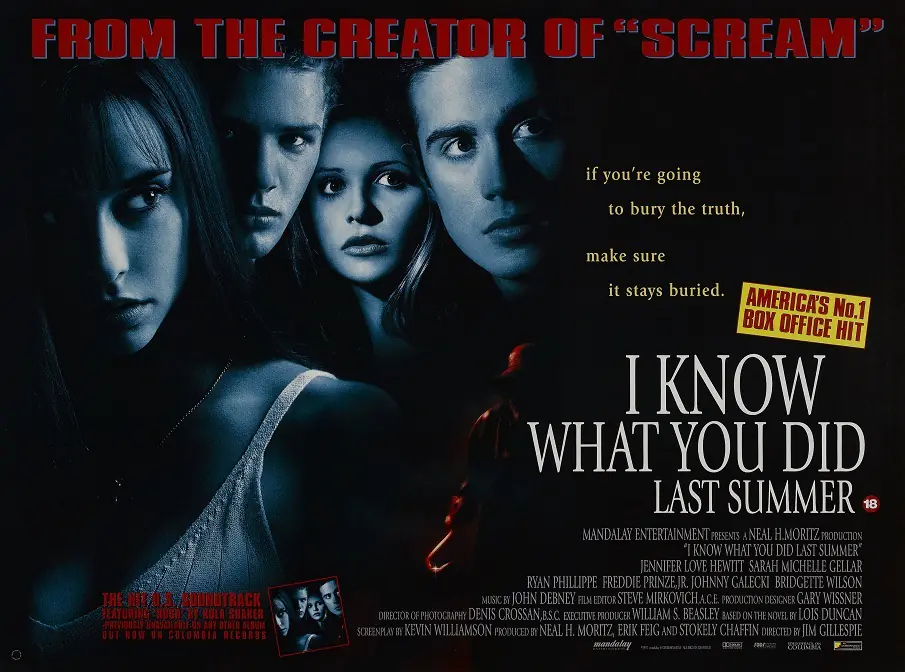
Let’s start with the fact that Gillespie’s film doesn’t try for a moment to transcend the genre’s boundaries. It finds its strength in a traditional approach and faithfulness to convention. We get four high school friends dreaming of leaving their small fishing town behind and starting adulthood. Their plans are derailed by a man in their path—while driving home one night, they hit him, and in a panic, decide to dump the body into the sea without telling anyone. A year later, the four of them become targets of a mysterious figure dressed in a fisherman’s slicker and armed with a large hook—someone who knows their secret.
The screenplay was based on a young adult novel by Lois Duncan, which featured no hook-wielding killer and instead used the plot primarily to deliver a cautionary tale about guilt and taking responsibility. Gillespie’s version still manages to convey this theme effectively, portraying the fatal event as the moment when the friends’ future dreams disappeared forever (though it’s worth questioning whether those dreams were ever achievable in the first place) and their friendship crumbled like a house of cards.
A year later, they’re strangers to each other, forced to reconnect in the face of danger. At first, it’s only about revealing the truth—which would land them in prison—but the mysterious stalker quickly makes it clear that he’s after a much more painful form of justice.

It’s also worth noting the killer’s figure, borrowed from one of the most popular American urban legends: a couple of teens are scared off by a man with a hook for a hand just as they’re getting intimate.
This story, dating back to the 1950s, can be read as a warning to sexually curious youth—or as a metaphor for sexual deviance, symbolized by the handless madman. The film’s characters even discuss the legend right before the accident (great timing). Julie, played by Jennifer Love Hewitt, says she doesn’t believe the story is real, but she does believe in its symbolism. The killer’s later appearance thus becomes a rude awakening—when a real murderer shows up, the meaning and function of the tale are suddenly much less important. Ultimately, Williamson settles for the costume only, without trying to give the killer traits that would elevate him beyond the standard horror villain archetype.
Too bad that before he uses his hook, the killer insists on playing a game of cat and mouse with the teenagers.
The entire middle section of the film is devoted to scaring the four teens and trying to figure out who the victim was and who’s stalking them. The scares have their highs and lows—though it’s hard to say which are which. Helen getting her hair cut sounds laughable in the context of a horror film, yet Sarah Michelle Gellar’s reaction is striking; on the other hand, the discovery and sudden disappearance of a crab-covered corpse from Julie’s car trunk is shocking and surprising, but her subsequent hysterical screaming already borders on the ridiculous (a scene hilariously parodied in the first Scary Movie).

At the same time, we follow an investigation led by Julie—a rather uninteresting, bland, and at times outright annoying character. She becomes the main protagonist the moment she’s the only one who, shortly after the accident, wants to go to the police. She’s presented as morally superior to her friends, but also as someone suffering more deeply from what happened a year ago. Naturally, we root for her, since she’s the only one trying to make amends, and Hewitt has that sad, sympathetic smile—but I wish the film had focused more on the other girl.
Not just because she’s played by Buffy, the vampire slayer. If Williamson had any chance to break the formula, it would’ve been by making the slasher’s heroine someone seemingly shallow—a parade queen dreaming of an acting career, now reduced to working in her sister’s store. But Helen turns out to be the one who’s changed the most—disillusioned about herself, longing for her lost friend (and able to say it), trying to help even if she’s too scared to admit her own guilt.
Eventually, though, tradition must prevail, and the hook comes into play. The third act allows Gillespie to deliver the suspenseful sequences viewers had been waiting for the whole film. The director surprisingly avoids gore and instead focuses on something else: the masked killer and his ambiguous nature. Some moments in I Know What You Did Last Summer suggest a supernatural element, as if the killer weren’t alive at all, but the very man the teens killed a year earlier.
When his identity is finally revealed, everything seems to be explained, yet it raises even more questions, placing the film more firmly in the realm of a thriller that pushes past the limits of realism.

I have to admit, revisiting I Know What You Did Last Summer nearly 20 years after last seeing it was quite enjoyable. Williamson follows the classic slasher formula point by point, while Gillespie tries to give the story a contemporary flair (helped most by the then-trendy music).
From a production standpoint, it’s a decently crafted film—the opening shot is the most striking, with the camera gliding just above the ocean, rising toward the cliffs and arcing to give us a perfect view of the ill-fated bend where the accident will occur, and more importantly, to draw us closer to the lone figure sitting on the hill. Performance-wise, the women stand out—not just Gellar and Hewitt, but also Anne Heche as the eerie sister of the deceased. The male cast is less impressive—Ryan Phillippe, playing the perpetually angry Barry, doesn’t have much to do but doesn’t embarrass himself either, whereas Freddie Prinze Jr. as Ray is painfully bad in every scene he appears in. Fans of The Big Bang Theory might be interested in Johnny Galecki’s brief appearance—but be warned, his character meets a quick, albeit stylish, end.
Maybe it’s nostalgia that makes me look more kindly on Gillespie’s film than it deserves. I don’t have many complaints about it as a teen thriller, and the late-’90s horror vibe works here almost as well as it did in Scream. But at the same time, this is a horror movie that really shouldn’t exist in a post-Scream world—a film that openly mocked everything that I Know What You Did Last Summer is built on. Williamson’s script (written before Scream, which explains a lot) feels dated and worn, full of intriguing ideas but so tightly bound to convention that everything—including the final scene—feels predictable. Well, maybe not everything. The screenwriter plays unfairly when it comes to the killer’s identity—it’s a surprise only because it’s someone the audience doesn’t know at all.
You could call it cheating on Williamson’s part, though in this kind of film, it’s not the most important thing.
The film’s success signaled to other filmmakers that there was room for slashers even after Scream—a fact they quickly took advantage of, though it didn’t result in anything as iconic as the late ’70s or early ’80s classics. Perhaps because all the creativity went into the marketing, while the films themselves failed to deliver even the basic horror requirement of shocking the viewer with bloody murder scenes (this also applies to the sequel, I Still Know What You Did Last Summer, set not in a fishing town but.
.. the Bahamas). The genre’s lightness inevitably led to fatigue, paving the way for Saw, Hostel, and other infamous representatives of torture porn. In the end, I Know What You Did Last Summer benefited simply from being made quickly and released right after Craven’s hit. That’s probably the only reason Gillespie’s film is still remembered today.
https://youtu.be/yiAlcLlJpQE


LUCIA’S GRACE. Resembles a Kind Of Missionary Endeavor

DOKUMENT. Short Film That Feels Monumental

BEAUTIFUL BOY. The Acting is Remarkable [REVIEW]

Looking Back at SPIDER: More Terrifying Than Horror
