
Review
THE OA Knows No Bounds: Real Shock Therapy
The OA seems to know no bounds, and in the finale it crosses yet another. For some it will be comparable to the revelation of Laura Palmer’s murderer.


I will begin by saying that writing about this series without going into details and revealing even minor spoilers is a perilous task. Nonetheless I must disclose something from the second and final (so far) season of The OA. I hope that I will not spoil the fun for fans of the first season, and for those who have not yet seen the series I recommend catching up first, because I describe the finale of the opening season here without restraint. You have been warned.
The first season of the OA, the series created by director Zal Batmanglij and starring Brit Marling, was a revelation, based on true, original narrative ideas, equally fascinating and frustrating.
The whole combined realism and mysticism, giving us no simple answer as to whether what we are watching is a record of the young woman’s real experiences or her hallucinations. We first met the titular OA as Prairie Johnson, later as Nina Azarova, and in the meantime we learned that as a child she lost her sight, only to regain it in adulthood, to disappear for seven years during which she was imprisoned and killed again and again, and upon her return to gather five listeners around her and tell them her incredible story.

It became a narratively captivating work that placed great emphasis on the process of storytelling itself, particularly its two functions—therapeutic and mythmaking.
As a result, the first season was both a bizarre drama about coping with trauma by sharing one’s imagination and an attempt at speculative fiction of a transcendental dimension that could not fully spread its wings until the very end. Season two proceeds more boldly than its predecessor and from the very beginning dots the i regarding whether Prairie’s story was real or not. And since the woman truly succeeded in moving to another dimension by following her lost love, Homer, it is difficult not to treat the new OA series as a fully fantastical, even science fiction, creation.
Marling feels at home in the skin of her character—more experienced, still emanating an aura of mystery and simple human kindness—a woman who must find herself in a new reality as someone she might have been had fortune smiled more on her in her previous world.
The question from the first season (who is Prairie?) is here replaced by another (who is Nina?), for although both women look identical, share some memories, and in a sense are the same being but in completely different dimensions, they differ in social status, behavior, and perhaps even nature. This by no means signifies that one is good and the other evil. The creators are interested rather in a broadly understood dualism—looking at the same life from two different perspectives and considering how the two possible versions correlate.

It is no accident that the second season is graced by the presence of Irène Jacob, known from The Double Life of Veronique, who at Batmanglij incarnates the mysterious Elodie, a woman with extensive experience in identity transformation. In parallel with the story of Prairie/Nina we watch the investigation of a private detective and learn the further fates of the friends the protagonist left behind in the previous world. All of these threads must eventually intersect (and it is worth remembering also the presence of the psychopathic Hap, with the face, as always reliable in such roles, of Jason Isaacs), but Batmanglij and Marling again do not hurry, leading their narratives along a winding—if not outright twisted—path. If the first season concerned the process of storytelling, in the second we virtually land in the very heart of the tale, no longer having the support of being able to dismiss OA’s story as a lie or a creation of a mad mind.
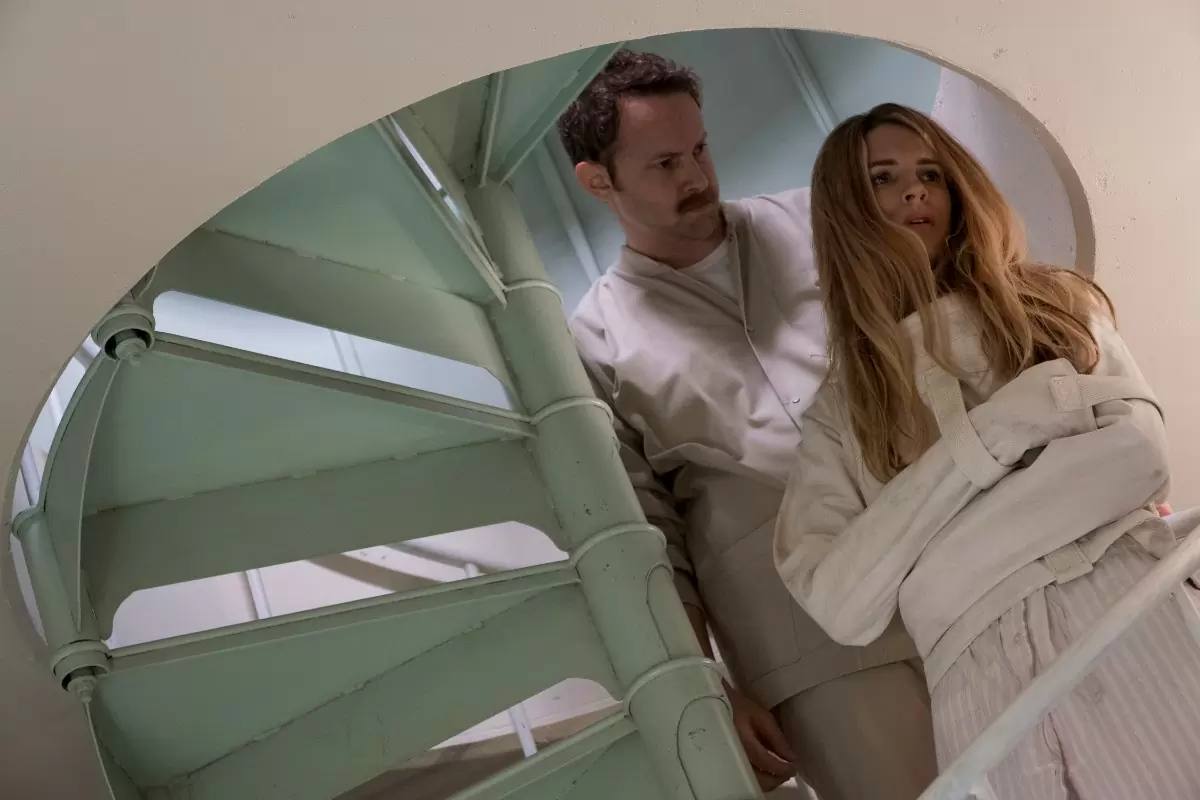
Then we could question the protagonist’s mental health (ironically, this season she ends up in a locked institution), but now, seeing that everything she said is true, we must accept the fantastical costume, the fairy-tale nature of the whole, and the mythology that is not only cosmic but also occasionally comical.
The creators wish to engage us completely; they want us to believe in the world (or worlds) they have created, not allowing themselves any distance from the material, which means that some daring ideas may simply appear ridiculous. Were the mysterious movement sequences in the previous season, resurrecting the dead and opening gates to another dimension, not controversial in their concept? Who did not doubt, upon hearing the expansion of the acronym OA? In the second part there are even more such elements, and one of the more digestible is the enormous octopus called the Old Night, speaking through a human medium after attaching its tentacles to her.
I repeat—it is this more digestible idea of the creators. Originality is OA’s greatest strength, but it may become its greatest weakness for those whom Batmanglij’s convention does not convince. The second season, perhaps even more than the first, constitutes a test of patience for a viewer accustomed to simple answers, dynamic action, and a comprehensible narrative flow. Perhaps that is why the best, because based on classical patterns, will be the thread of the private detective, Karim, hired to find a missing teenager. The crime investigation takes us to a house where people go mad or die, and to a factory of sleepers where dreams are recorded and analyzed, but despite these fanciful ideas the investigation here is extremely clear and engrossing. How it relates to the OA thread I will not reveal, although from the moment the fates of Karim and hers intertwine the plot gains momentum, also because there is great chemistry between Kingsley Ben-Adir as the detective and Marling.
It is a pity that the characters from the previous series, boys and BBA, are this time completely superfluous. It is true that their episodes are closest to what OA was in the first installment, combining realism with just a hint of fantasy, and also engage emotionally the most, but in the end they contribute little to the parallel stories unfolding in the dimension to which Prairie has gone.
It is apparent how much Batmanglij and Marling did not want to give up the peculiar nature of that story, yet the second season in its very foundation is different. It expands the universe with new elements, making reality even less real but richer and more astonishing. Visually and conceptually it makes an impression, but the price for that must be the necessity of departing from the intimacy and coziness so characteristic of the first season. This is by no means a criticism—the series, like its main character, has evolved, leaving behind the reality and the people who simply must come to terms with the changes. This also applies to Prairie’s parents, practically absent and again portrayed by Alice Krige and the late Scott Wilson.

OA remains a brilliantly told story, though now more focused on creating its own mythology than on delving into the relationships between Prairie and the other characters. New characters have appeared (the aforementioned Elodie or Fola possessed by the completion of the interactive game, portrayed by Zendaya), but they seem more like figures than flesh-and-blood personalities, perhaps except for Karim.
Those we know from the previous season are relegated here to a distant secondary role, surprisingly inconsequential in the continuation (Rachel, Scott, Renata) or simply uninteresting (Homer). Hap goes even further in his extreme experiments, but this does not enhance him as a character; if anything, it only cements his status as the series’ main villain.
However, the second season will be a feast for fans of speculative fiction, especially of a literary kind, not far from the ideas of Jeff VanderMeer, though to me reminiscent especially of Mark S. Huberath’s The House of Worlds. OA has room for parallel dimensions, religious symbolism, dreams, dancing robots, ancient mind-reading octopuses, and flowers possessing the memories of many incarnations.
All of this harmonizes surprisingly well, demonstrating Batmanglij’s mastery in juggling elements that seemingly do not fit together. The richness of this world seems to know no bounds, and in the finale it crosses yet another, returning in a sense to what in the first season was its essence—storytelling. But for those waiting for the answer to the question of who is telling what to whom, I advise preparation for a considerable shock. For some it will be comparable to the revelation of Laura Palmer’s murderer, for others to the experience of watching Dexter’s final, so nightmarish episode. As for me, I even enjoyed it.


LUCIA’S GRACE. Resembles a Kind Of Missionary Endeavor

DOKUMENT. Short Film That Feels Monumental

BEAUTIFUL BOY. The Acting is Remarkable [REVIEW]

Looking Back at SPIDER: More Terrifying Than Horror
