
Review
THE NEW POPE: Paolo Sorrentino’s Ode to Narcissism
After the magic of the first season—with its extraordinary visual layer and its sober approach to faith’s meaning—only the aesthetics remain in The New Pope.


The great cross pulses with the multicolored lights of neon, and before it “liberated” nuns dance in white habits. Club music thumps in the background, the lead singer of Sofi Tukker sings that one may call her good time girl. The opening credits of The New Pope resemble the worst nightmares of young clerics, for every shot literally explodes with excessive sensual stimulation. A bacchanal of God’s bodies in honor of the Highest is now underway.
Warning! This text contains plot spoilers!
Paolo Sorrentino, with his characteristic panache, begins the second chapter of the story of those holding the highest offices in the Vatican. Recall: at the end of the first season, the reigning Pope Pius XIII (Jude Law) falls unconscious under mysterious circumstances. Weeks pass, and the pontiff lies in a coma with no sign of recovery. He is transported to Venice, where, under twenty-four-hour medical care, he is miraculously kept alive.
Yet disconnect one tube, and all hope would vanish.
And since the throne is vacant, a new occupant must be found. Press releases hinted that Sir John Brannox, played by John Malkovich, would succeed Pius, so the director’s delicious joke is to depict a conclave that elects someone else. Imagine viewers’ surprise when, instead of the popular actor, the cardinals choose a priest known from season one—one who behaves like Francis of Assisi, renouncing wealth for poverty and service to others. The first episode of The New Pope should be read as the Italian director’s response to public demand for commentary on the contemporary Catholic Church. And the artist’s message is this: the Curia is not ready for a material revolution. Then, in episode two, he shifts from digression to the central narrative.

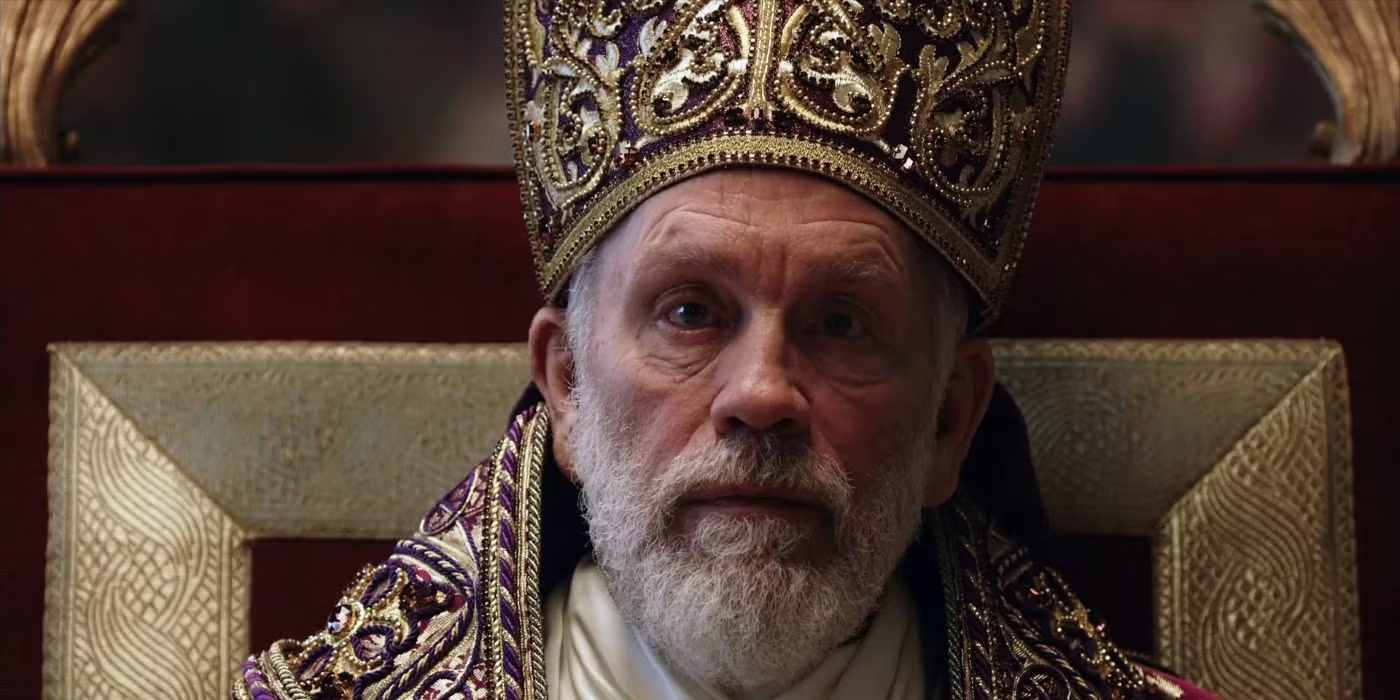
Much of the second season revolves around the new pope—his spiritual state, his traumatic past, and the message he intends to carry to the world. John Paul III, as played by Malkovich, is the opposite of his predecessors.
Although the faithful treat him as an authority on matters of faith, he himself claims that God does not like him. His portrayal resembles a Catholic riff on Oscar Wilde. He lives in a family castle surrounded by ornate wall decorations, paintings, and other expensive baubles with which he attempts to fill the void that has long resided in his heart. His painful past—a sense of responsibility for his twin brother’s death—stalks him like the Grim Reaper, giving him no chance at normal life and isolating him from others. Brannox behaves like a textbook decadent, waxing poetic on beauty and the passage of time.
The protagonist, so compellingly sketched at the season’s outset, becomes a millstone around the series’ neck with each passing episode. Sorrentino seems unsure who this pope is meant to be or what he represents. His actions merely echo those taken by Lenny Belardo. The shouted “no” after the Lourdes bombing lacks the power of Pius’s earlier declaration “we have forgotten.” The series is like John Paul III himself—fragile as porcelain, crumbling dramatically with every attempt to interpret its on-screen events. He lacks the charisma to carry the production, offers no room to explore his tormented conscience, and endlessly talks about himself while remaining inert in his actions.
He is like an eroding statue set upon a pedestal.

It is telling that the director frequently loses interest in the new pope, meandering the plot among secondary characters. At one moment he explores a rebellion of nuns living in the Vatican, then examines the relationship between Cardinal Voiello and his protégé Girolamo, then follows the trials of Esther, the pope’s ailing friend who uses her body to rescue those harmed by life’s cruelty. None of these threads is ever fully developed.
The characters appear as if straight from the pages of the Bible—walking allegories of virtues and sins that humanity must daily contend with.
Nine hour-long episodes compose a marathon of narcissistic tributes that Sorrentino pays himself. From a certain point on, nothing in his cinema may approach normality, even slightly. If he depicts departure, it is in the context of children struck by tragic diseases. If he reveals the clergy’s sexual debauchery, it is necessarily in lavish sets, as an orgy with a minor.
Everything must be opulent, sumptuous, with a slow-gliding camera and obligatory strings playing a moving melody. The dialogue is similar: characters do not converse but recite successive verses of aphorisms, parables, and revealed truths.

For this reason, his techniques ridicule his chosen narrative strategy rather than deepen it. The conversations of John Paul III with guest stars—Marilyn Manson and Sharon Stone—are The New Pope in a nutshell.
Their meetings are surprising, bizarre, but in their own way interesting, especially when figures from two utterly different religious, social, and cultural orders are juxtaposed. There are comic moments—particularly when Brannox refuses to watch an actress crossing her legs—but none of these scenes lead anywhere. Sorrentino is so enamored of his formula—where high meets low, comic meets tragic, absurd meets serious—that it becomes an end in itself. Celebrating one’s own uniqueness can be healthy, but only to a point. The Italian repeatedly crosses that line.
The director of The Great Beauty can no longer tell a sincere story.
His imaginarium consists of countless trinkets wielded instrumentally to achieve predetermined ends. So it is with Voiello’s recurring monologues about the Napoli football team, with threads on clerical pedophilia, Curia financing, papacy-laity relations, priests’ homosexual relationships, or the threat of Islamic fanatics. These topics function as bait for controversy-hungry viewers, for they are never resolved. This is especially evident in the subplot of the caliph who menaces Catholics—an enigmatic antagonist who hunts the faithful like the Night King from Game of Thrones stalking the residents of the Seven Kingdoms.
Yet when it comes to a final showdown between papal and Arab forces, the matter suddenly fades away. It is hard to imagine a poorer resolution of that thread.

To justify these indictments, one needs only compare the early episodes with those in which a healthy Lenny Belardo appears. It takes but a moment to see what a tremendous asset Belardo was in season one—charismatic, self-important, the successor of Saint Peter. Jude Law’s return to the series is the best thing that could have happened to The New Pope, for with him came mystery back to the show.
Recall: Pius’s latest season echoes his thesis on the treatment of the faithful: one should only gently open the Church’s doors to them. If they wish to participate in the religious mystery, they must meet the requisite conditions and conform to its rules—yet still receive no answers to their most important questions.
That was precisely The Young Pope, in which Sorrentino avoided definitively stating whether Belardo was a prophet or perhaps the Antichrist.
Thanks to that ambiguity, he created a multilayered tale, and it was up to each viewer’s perception and disposition to decide which key would unlock the story. Meanwhile, The New Pope is bereft of that mystical aura. It is very “everyday,” even though the creator strains to restore its earlier atmosphere. In vain—the chance is lost.

A viewing of Paolo Sorrentino’s series is deeply disappointing.
After the magic of the first season—with its extraordinary visual layer and its sober approach to faith’s meaning and religion’s existence—only the admirable aesthetics remain. Yet viewers should not form opinions based solely on sensory pleasures. They should not follow the visual delights, as Sorrentino does, exponentially increasing the number of naked women on screen in his recent films. These are mere trinkets masking a lack of ideas for crafting an engaging story framework. Instead of flesh-and-blood people, we see a series of empty, more or less eccentric gestures. Not enough.


LUCIA’S GRACE. Resembles a Kind Of Missionary Endeavor

DOKUMENT. Short Film That Feels Monumental

BEAUTIFUL BOY. The Acting is Remarkable [REVIEW]

Looking Back at SPIDER: More Terrifying Than Horror
