
Review
STUTZ. Psychotherapy straight from streaming
Sure, Stutz is a heavily stylized documentary that somewhat artificially addresses the idea of “truth in documentary” and tries to deconstruct the boundaries.


What happens when a famous Hollywood actor decides to make a documentary about his relationship with his psychotherapist? It could become the most artificial thing in Netflix’s library—or the most authentic. In reality, Stutz, directed by Jonah Hill and documenting his conversations with his therapist, lands somewhere in the middle on the authenticity scale.
Jonah Hill has been openly discussing his mental and emotional struggles for years.
The actor, who early in his career was mostly recognized due to his noticeable overweight, continues to battle anxiety and insecurities rooted in those early years—despite being in much better physical shape today. A two-time Oscar nominee, Hill has never hidden the fact that he’s been seeing a psychotherapist for years. But this time, his openness and transparency have reached a whole new level. Hill decided to make a documentary in which he talks with Phil Stutz, a well-known American psychiatrist and author of the bestselling book The Tools, which outlines a method he developed for transforming pain and trauma into creative potential. Hill and Stutz have worked together for years, during which the 74-year-old psychiatrist has helped his client—almost half his age—work through many painful issues, some of which are revealed in the documentary. Stutz aims to introduce a wide audience to the concepts developed by this respected psychiatrist, concepts that may turn out to be a surprising source of relief for troubled souls.
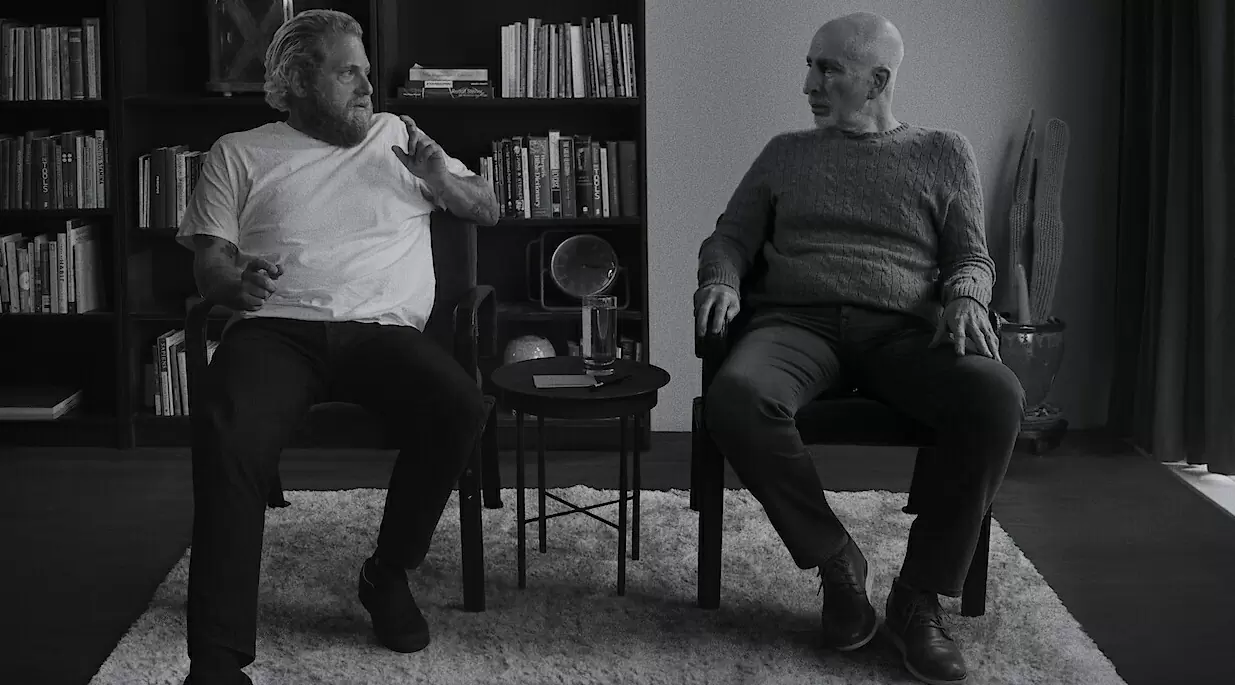
I must admit, Stutz made a huge impression on me. It’s not just the idea—which initially seemed rather risky—but in the end, Hill managed to skillfully combine a biographical documentary with a genuinely valuable message and an unintended diagnosis of modern society. In a time when more and more people are turning to therapists, psychologists, and psychiatrists, this kind of insight into the work of one (or all?) of these professionals is incredibly valuable. So, if you’ve never sought out this kind of mental or spiritual support but are curious about what it might look like, Stutz is definitely a film for you.
You can think of it as a cinematic version of Psychotherapy for Dummies—or, to paraphrase Woody Allen, Everything You Always Wanted to Know About Psychotherapy but Were Afraid to Ask. Stutz is a documentary without a didactic tone that explores the intricacies of the work of just one psychiatrist—but one who is deeply compelling and clearly cares about what he does.
Some of the terms coined or redefined by Phil Stutz can be quite enigmatic. So when you hear about “stringing pearls” (which, warning, might also contain… crap!), “active love,” or “Part X,” you’ll need to listen closely to fully grasp their meaning.
It’s not that these are difficult concepts—they just require complete attention. Only through focused engagement can you fully comprehend these somewhat abstract ideas and, perhaps most importantly, relate them to your own life. I must say, it’s been a long time since I watched something so consciously—where I analyzed every word and tried to apply each new concept to my own experiences and find examples in my life that align with Stutz’s methods. Jonah Hill’s documentary isn’t just a thought-provoking film—it’s an exercise, one that demands full concentration but rewards the viewer with greater self-awareness and insights into aspects of themselves they may not have previously recognized.

Sure, Stutz is a heavily stylized documentary that somewhat artificially addresses the idea of “truth in documentary” and tries to deconstruct the boundaries of cinematic reportage. But the core goal of this experiment is fully achieved: Phil Stutz is given a powerful platform to share his methods and reach millions of people. And while we, Polish viewers, may not rush to our screens to look up Dr. Stutz’s clinic number, I wouldn’t be surprised if viewers in the U.
S. did just that. Because in the methods created by this psychiatrist, many may find solace—and for that reason, Stutz can be called a healing film.


LUCIA’S GRACE. Resembles a Kind Of Missionary Endeavor

DOKUMENT. Short Film That Feels Monumental

BEAUTIFUL BOY. The Acting is Remarkable [REVIEW]

Looking Back at SPIDER: More Terrifying Than Horror
