
Review
SCRUBS. 15 Years On, and Still Hopelessly Funny
Scrubs is a multilayered construction, in which the absurd situations of the main characters and occasionally bizarre jokes are just a starting point.


Nothing pointed to success… – the stories of many productions that are now considered cult classics could begin with these words. And that’s exactly why we love them – because they outsmarted the decision-makers of the entertainment industry, who kind of approved something, kind of gave it a chance, but most often just to have peace of mind and cancel the broadcast after a few weeks. Scrubs could have shared that same fate, but unexpectedly turned out to be the show that, at the beginning of the 21st century, reconciled fans of Friends and ER, who kept arguing over which of the two was superior.

May 6 marked exactly fifteen years since J.D. and company left Sacred Heart Hospital. That’s an awfully long time – many shows pulled off the air simply vanish after that many years, fading into the depths of human memory – but not Scrubs. No one else entertained in quite the same way, while also smuggling in incredibly important life lessons under the cape of absurdity.
Sometimes it was tear-streaming hilarious, other times it was tearjerking in a serious way, but this is one of the few productions that truly stuck with me. I feel like I saw the last episode just a few days ago… oh wait, hang on. That’s actually true, because for some TV stations this series is simply immortal. And thank heavens for that!

You might think the comparison to ER and Friends is an exaggeration, but remember that Scrubs premiered twenty four (sic!) years ago, right at the height of those two shows’ popularity – and as if unfazed, it decided to throw down the gauntlet.
Of course, it lost. The first season averaged just over ten million viewers, which was only about half the ratings those two giants were pulling in at the time. But that was still more than NBC ever expected. It’s worth knowing that Scrubs was never associated with any real hopes. You can see that very clearly when comparing the first season with every season that followed.

Scrubs is the greatest work of Bill Lawrence, who neither before nor after ever reached such success again.
The creator himself wasn’t even sure if he’d manage to get through the first season. The show’s early steps were nearly as uncertain as John Dorian’s (Zach Braff) entry into a brand-new world that would come to define his professional life for years to come.
The vast majority of the show’s action takes place in Sacred Heart Hospital, full of bizarre medical cases – and by that, I mostly mean the staff, not the patients. The main character, and also our narrator, is John J.D. Dorian – a freshly minted resident. A dreamer who often drifts into fantasy mid-conversation, he’s such an absurd character that you can’t help but like him.
But that’s just the beginning, because every person who appears on screen more than once has their own, equally offbeat story to tell, just waiting for us to dive into this seemingly unserious medical world…

As I mentioned, the first season stands out quite a bit from the rest – it was good, but you can sense a lot of hesitation. Bill Lawrence was trying to be cautious, hoping the show would stay on NBC’s schedule for another year. Paradoxically, Scrubs only found its proper rhythm when the creator lost hope for success.
The key was the response: instead of giving up, Lawrence decided to remove all the restrictions from himself and the actors – the kind that had kept the humor in check for the first dozen episodes or so, all in the name of political correctness. This shift, clearly visible in the final stretch of the first season, set the tone of absurdity that became the series’ trademark right up to the end – a level of absurdity no other show has ever even come close to. But all the jokes would’ve been pointless without the incredible chemistry between the lead actors.
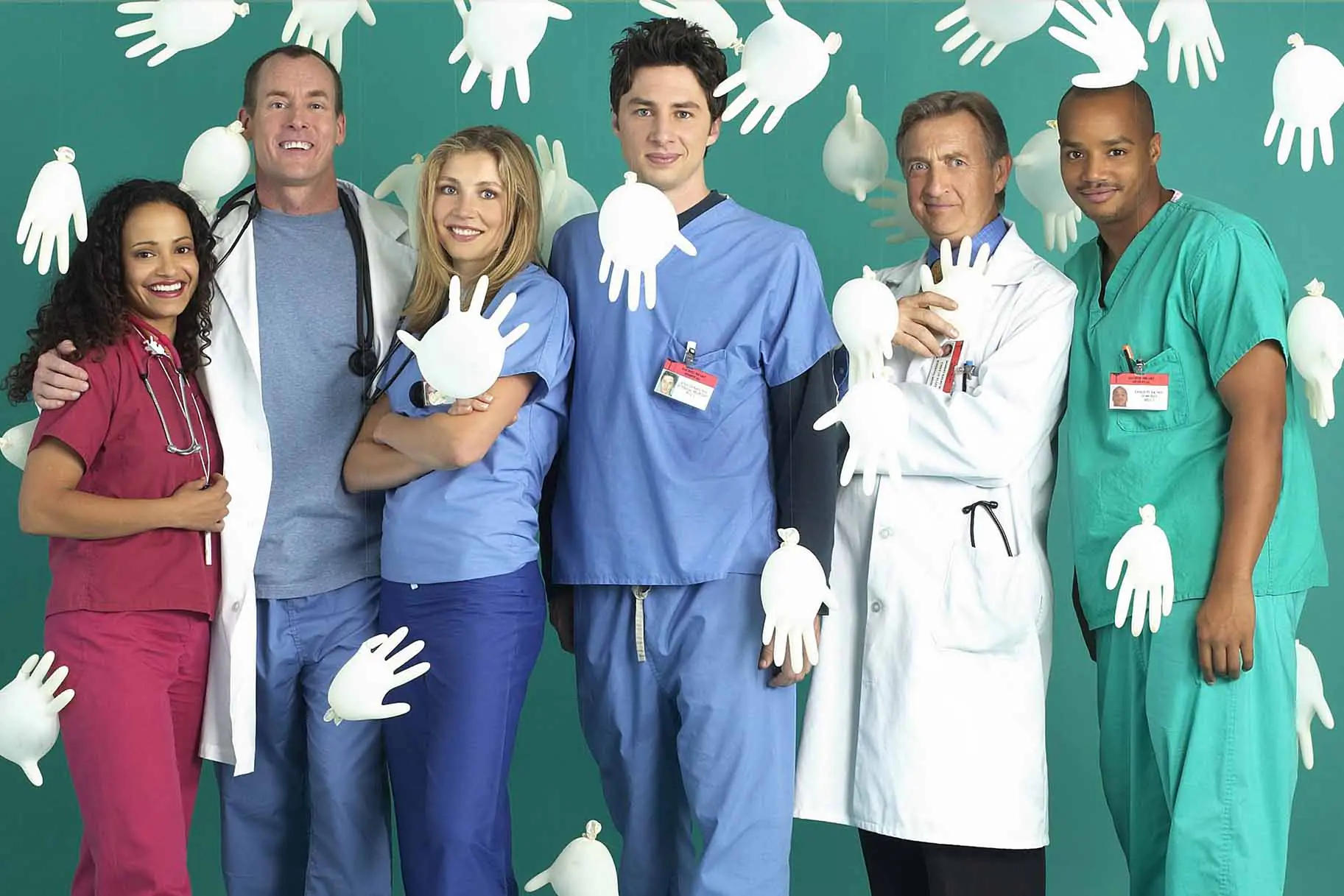
Scrubs is, contrary to appearances, a multilayered construction, in which the absurd situations of the main characters and occasionally bizarre jokes are just a starting point. Beneath the humorous surface lies incredibly deep and profoundly human content. In the series, we see three generations of doctors: J.D. and his peers answer to Dr. Cox (John C. McGinley), who in turn has to listen to the hospital’s director – Bob Kelso (Ken Jenkins) – but over time, their roles begin to shift. Just like in life. It perfectly illustrates the path one has to take not only to achieve professional success but also to understand those we once held grievances against when we were their subordinates.
Each character is written so compellingly that you could easily rewatch this show a dozen times, each time focusing on a different character’s life, and still never get bored despite watching the same scenes over and over.

What must be emphasized is how effortlessly the show leapt between tropes, mocking them and turning even the most self-assured truths into jokes – the kind of joke that life itself essentially is. In the past sixteen years, I’ve come across only one other show that could play with genre clichés as smoothly while giving them its own meaning.
That was Legion, which by default puts Scrubs in the top tier. Though categorizing it is completely unnecessary here.
Tough guys cry, the biggest enemies become friends, and a comedy series portrays a man’s death as if it were teaching us how to live. Without pompous monologues, without needless nostalgia, but with a huge dose of positive emotion. I could go on talking about Scrubs for ages, but if you know the show – it’s pointless, because you already know that the best cure for any ailment is a box of kittens.
And if you haven’t seen it, you simply need to catch up and draw your own conclusions.

JUST REMEMBER ONE THING: don’t let anyone convince you that this show has nine seasons. The story of John Dorian ended on May 6, 2009, and everything that came after – every attempt to keep the Scrubs brand alive – was nothing short of a crime. I can understand that ABC wanted to cash in on the rights it acquired from NBC in 2007, but why they thought they could replace 90% of the cast and keep the show going – that will forever be a mystery to me.
Even adapting Dr. Acula (one of the show’s running jokes) would’ve been a better idea.


LUCIA’S GRACE. Resembles a Kind Of Missionary Endeavor

DOKUMENT. Short Film That Feels Monumental

BEAUTIFUL BOY. The Acting is Remarkable [REVIEW]

Looking Back at SPIDER: More Terrifying Than Horror
