
Review
ROME: Simply Excellent and Definitely Too Short
In its final two-season form Rome remains an excellent series, crafted with great care and using its historical starting point to create an engaging narrative.


Ancient Rome has almost always fascinated filmmakers, who eagerly create their own versions of its most famous historical events. Among the most popular subjects is undoubtedly the transformation of the republic into an empire, perhaps one of the most significant political upheavals in history, with Julius Caesar in the leading role. John Milius, William J. MacDonald and Bruno Heller set out to tell this very story in all its complexity in Rome, the HBO and BBC production of 2005–2007—a series both outstanding and ultimately unfulfilled.
Rome presents the story from two interweaving perspectives: the aristocrats plotting intrigues and vying for power and prestige, and the ordinary inhabitants of the city who carry out their orders. The latter viewpoint is embodied by two legionaries, Lucius Vorenus and Titus Pullo. We meet them during the Gallic War and follow their fates as they are shaped by each subsequent political decision of Caesar, his allies and his adversaries. The patrician and plebeian strands develop largely independently over the course of the series, yet they revolve around the same events and processes, occasionally converging directly.
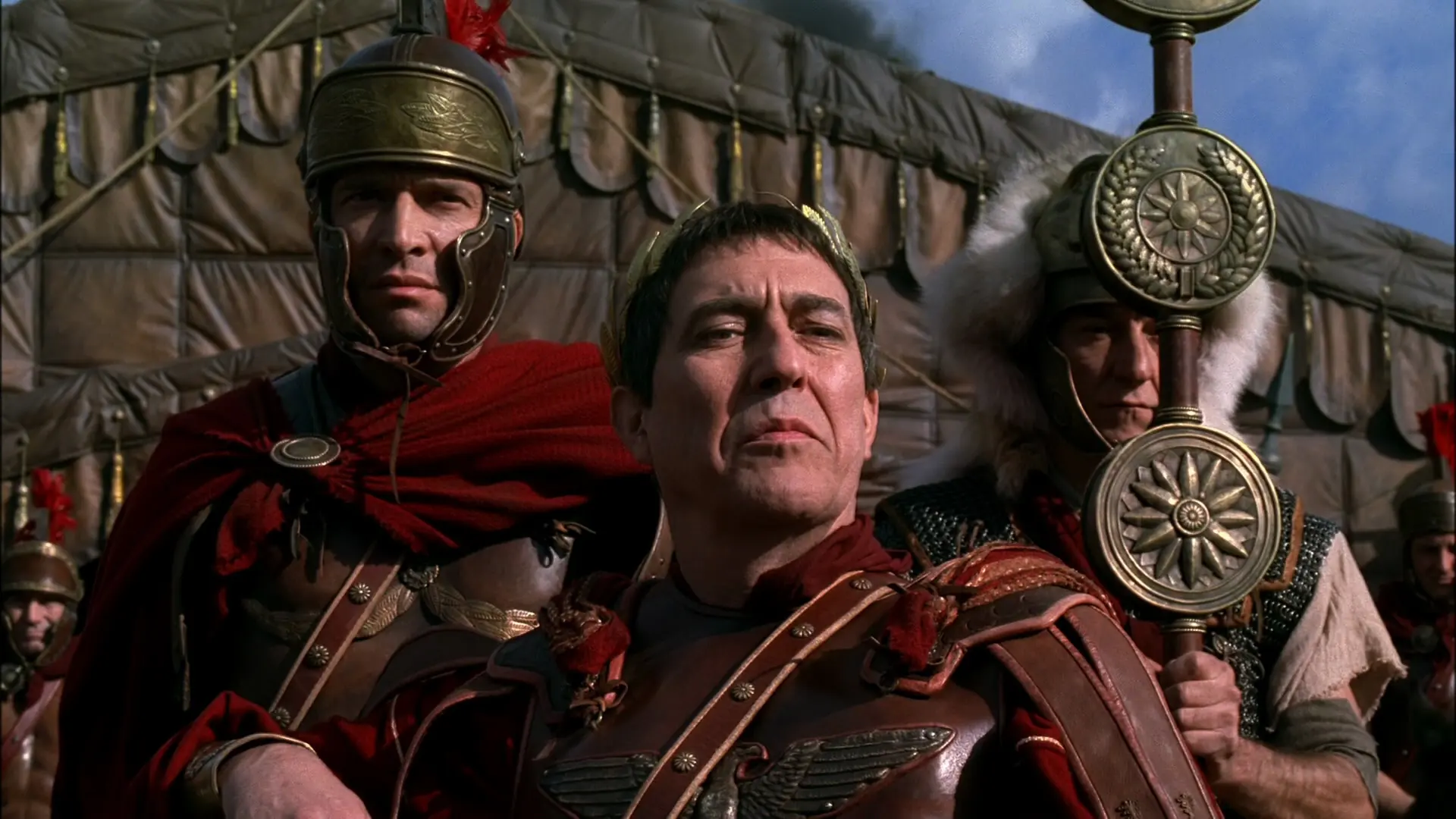
In this way, we receive a believable portrait of how every layer of society became entangled in the historical maelstrom—a portrayal that is dramatically compelling thanks to its diverse narrative threads. The decision to fragment the narrative among characters dispersed throughout the depicted world—a technique less obvious at the time Rome was produced than it would be today—remains one of the series’ most intriguing formal devices. One of Rome’s greatest assets is its gallery of characters as brought to life by the creators.
Ciarán Hinds delivers a memorable performance as the legendary politician, revealing in him the ambivalence of a dangerous egocentrist and a visionary ruthlessly pursuing power and a place in history.
Equally engaging are the portrayals of figures such as Mark Antony, Atia, Brutus, Pompey the Great and Cleopatra. Well-known historical personages are shown in Rome as undignified men and women—petty, ruthless and cruel. The depiction of Octavian Augustus (played first by Max Pirkis in the first season and then by Simon Woods in the second) is particularly noteworthy: a ruler often idealized, yet in Rome presented as a monster devoid of feeling, rising from a promising youth to destroy everything and everyone in his path.

The lower strata of society are flawed as well—our protagonists Vorenus and Pullo, portrayed convincingly by Kevin McKidd and Ray Stevenson, are indeed the most sympathetic figures in the series, yet they too possess faults that frequently land them in further trouble. Their side stories also expose a society riddled with moral decay and cruelty, living in filth and poverty alongside the debauched elite. Crucially, no class in Rome is depicted as better than any other—the decline seems to affect all equally, regardless of social standing.
The first season of Rome is an outstanding historical drama depicting Julius Caesar’s rise to power, from the Gallic War up to the infamous Ides of March. The parallel tales of Caesar and his Gallic veterans intertwine into an intriguing socio-political panorama of a state evolving from a hypocritical republic into a merciless empire, and of a city torn apart by internal divisions. The uncompromising vision of history strips ancient Rome of its classical sheen, presenting a world corrupted and ravaged by economic and social inequalities—strikingly resonant with many aspects of the modern era.
At the same time, the creators successfully merge swift, brutal action with compelling intrigues, ensuring that Rome never grows dull and delivers rich, ambitious entertainment.

The second season of the series, which chronicles the turbulent aftermath of Caesar’s death—namely the fortunes of the Second Triumvirate formed by Octavian, Mark Antony and Lepidus to stabilise the state after the ruler’s demise, culminating in the conflict between Antony and Octavian that ultimately cemented the imperial system—does not quite match the first.
Although the second series maintains a high standard in character development, the interweaving of patrician, soldierly and plebeian narratives, and in its overall vision of the world, its coverage of some fifteen eventful years becomes more frenetic and abbreviated.
The finale feels (rightly) hurried, as though the creators were merely checking off key plot points, to the detriment of individual storylines. James Purefoy’s superb portrayal of a lost Antony is thus given insufficient room to resonate, and the exciting first-season arc of Vorenus and Pullo, now placed on opposite sides of the barricades, loses much of its momentum and becomes subordinated to political machination.
This state of affairs was not due to any lack of skill on the part of the creators but to production upheaval. They had originally planned five seasons—one in its known form, a second focusing on the triumvirs’ vengeance on the conspirators, two more depicting the war between Octavian and Antony, and a fifth centred on social currents and the activities of Jesus of Nazareth in the provinces.

Those plans were thwarted when HBO, citing high costs and insufficient returns, decided during production on the second series to end the show after two seasons.
Consequently, the writers had to condense three planned seasons into one, abandoning the narrative of the final season. The resulting narrative haste of the second season somewhat undermines Rome’s overall impact, clashing with its meticulous production values and exceptional psychological portraits. The cuts and leaps are jarring, especially when contrasted with the impeccable pacing of the first season, in which the creators fully realised the potential of their vision of Rome. The restrained scale and narrative discipline left a strong impression, standing alongside the acting as the series’ finest elements and sustaining a consistently high level almost throughout.
One cannot help but regret the decision to cancel the series, for in its full five-season form Rome might have become a masterpiece of contemporary television. It is worth noting that the principal roles were entrusted to talented but relatively unknown actors of the second tier, who could inhabit their characters convincingly without giving viewers the sense of watching a star in the role, while also providing ample space for their skills to shine. The series’ distinctive rugged realism avoided gratuitous cruelty, and even in its frenetic conclusion the drama remained at the highest level. Ironically, it was precisely this attention to detail and commitment to realism in portraying antiquity that led to the show’s downfall—its cancellation on account of excessive costs.

Despite its unfulfilled potential, in its final two-season form Rome remains an excellent series, crafted with great care and using its historical starting point to create an engaging narrative about its characters and their world. The series also possesses a freshness that is so hard to achieve when depicting a story known the world over.


LUCIA’S GRACE. Resembles a Kind Of Missionary Endeavor

DOKUMENT. Short Film That Feels Monumental

BEAUTIFUL BOY. The Acting is Remarkable [REVIEW]

Looking Back at SPIDER: More Terrifying Than Horror
