
Horror Movies
NIGHT OF THE LIVING DEAD: Romero’s Trailblazing Masterpiece
Remove the zombies from Night of the Living Dead and we see we need them not to turn our lives into hell. Hatred and stupidity are the true domain of the living


Sometimes the titles of older, almost classical films lose their specific meaning, becoming labels for an entirely different kind of cinema—a simplification born of the name’s becoming commonplace. Perhaps this is best illustrated by horror films, which often indulge in very graphic, unsubtle naming. When we think of The Texas Chain Saw Massacre, do we picture Tobe Hooper’s work, considered one of the genre’s most important entries, or merely a type of horror—exceptionally brutal and unpleasant, a forbidden fruit—reflecting more our attitude toward that sort of cinema than its true merit? That title has become so ingrained in our consciousness that even without knowing the film, we understand what it signifies.
Likewise Halloween, the slasher about a masked murderer—how many times have we seen that same template on screen? Yet one viewing of John Carpenter’s film makes clear that the original is by no means a B-movie gorefest, as the title might now suggest. And Night of the Living Dead?
Those five words alone create certain expectations (or dash them)—hardly a starker example of a title both enticing and repelling the potential viewer. We all know it is a zombie film, even though the word never appears in George A. Romero’s debut. Following that logic, might someone unaware of the film’s content, seeing only Night of the Living Dead, assume the movie itself is as mindless and bloodthirsty as its titular creatures?
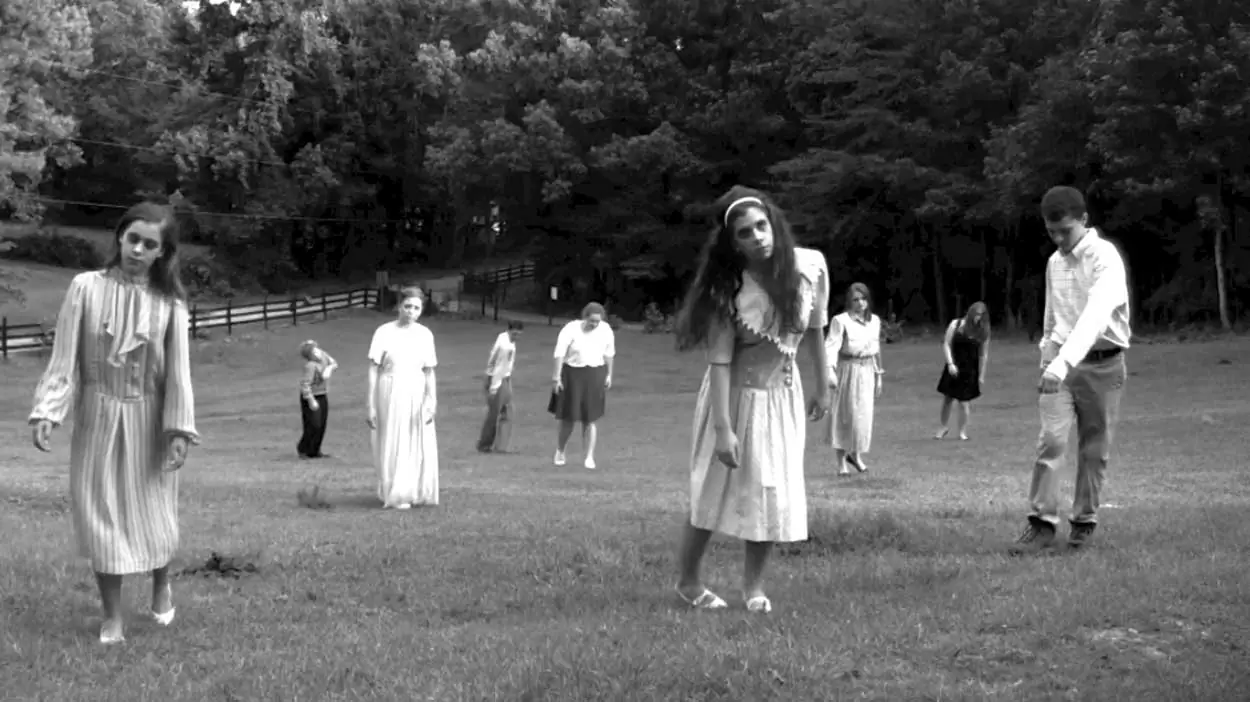
Of course, as with the finest zombie tales, the living—not the corpses—are front and center. Romero’s horror, however, opens on a cemetery, where siblings arrive to visit their father’s grave. The brother dislikes the trip—he must spend hours in the car for a man he barely remembers. Bored, he scares his sister (the famous They’re coming to get you, Barbara), then mocks her prayer and even her fear of death. It is no surprise that Johnny (Russell Streiner) quickly becomes the first victim of a shambling corpse.
His terrified sister, Barbara (Judith O’Dea), escapes to a nearby farmhouse, finding refuge in an apparently empty house.
She is soon joined by Ben (Duane Jones), whose strength and resourcefulness offer hope of defending against the growing horde outside. Unfortunately, other survivors are hiding in the house, and conflict between Ben and the boisterous, cowardly Harry Cooper (Karl Hardman), who occupies the cellar, threatens them all. Thus the title monsters serve both as the primary menace and as a catalyst for human aggression.

Few plots are more recognizable: a small group trapped in a house fighting to survive against an unknown foe.
Many later horrors borrowed from the template Romero and co-writer John A. Russo created, using confined spaces to build claustrophobic tension and interpersonal drama. Night of the Living Dead exploits these conditions well, though one might argue whether it is the most skilfully crafted film dramatically or technically. Its low budget is plainly visible—technical flaws abound, from often blurry cinematography to uneven performances, and the score sounds ripped from 1950s sci-fi horrors.
This is not a film that has aged gracefully, yet its roughness, cheapness, and even its black-and-white stock serve its realism and documentary style.
We remain immersed in the action, close to both the living and the dead. Romero’s achievement lies in stripping horror of decoration and artifice—eschewing gore for spectacle in favor of a traumatically visceral experience. No wonder that nearly sixty years ago, when Night played in afternoon matinees—even for children—it caused quite a stir. Its grim atmosphere and nihilistic message stem not only from graphic violence (cannibalism was a novel twist for zombies) and the unfair, often random deaths, but also from the unsettling suggestion that horror had surpassed its genre confines and the movie screen itself.

Night of the Living Dead in a sense erased the barrier between viewer and story—an incredible rarity in the genre—by demanding submission to its austere style, making the mere disordering of natural and moral order more terrifying than the recently deceased. The reanimated dead violate the laws of nature and religion, a philosophical abstraction redefining human history and marking the dawn of a new reality.
Today, this is often forgotten—zombie films and series have become commonplace not for their one-note premise of avoiding bites and shooting heads, but because they stopped asking deeper questions about the state they depict.
I can forgive Russo and Romero a reference to a satellite sent to Venus as the trigger for the dead’s resurrection, since the film is suffused with a sense that the end has begun—whatever the future holds for its characters, nothing will ever be the same.

The film has been read in many ways: as a critique of the Vietnam War, a vital commentary on race relations, a sociological portrait of a divided America—seeing in the living dead a metaphorical rather than a typical genre antagonist.
It is no surprise, for zombies are always featureless, characterless revenants driven solely by the need to kill and consume. An ungrateful protagonist, unless the creators care more about the message than the monster. And though Romero denied that critics’ readings were intentional, it is hard to believe otherwise when one examines his subsequent films.
In The Crazies (1973) the U.S. government develops a biological weapon that is accidentally unleashed on its own citizens, and when the military intervenes, politicians debate whether it might be best to drop an atomic bomb on the infected town.
His masterpiece, Dawn of the Dead (1978), moves the horror to a shopping mall, using zombie hordes to critique consumerism, highlighting real danger in everyday mindlessness. In Knightriders (1981), protagonists flee by adopting medieval chivalry rather than modern thinking.

Romero was a unique voice in horror—his socially satirical edge bled into relentless depictions of gore, yet he always pointed back to a reality we share.
His concern for his country and human condition rarely felt moralizing; as a keen observer of the here and now, he cloaked his reflections in horror’s garb, sneaking in important themes. Not all his films aspired to profundity (the black-comedy Creepshow and the eighties’ Monkey Shines aimed primarily for entertainment), and some lost force over time (Day of the Dead from 1985 shows a clear, enduring drop in his form), but among his contemporaries Romero stood alone as a political horror auteur—less a genre than a singular cinematic language he invented and used like no one else.
It is no accident that Night of the Living Dead was inducted into the Library of Congress’s National Film Registry as culturally, historically, and aesthetically significant. Though shot in black and white, its bitter irony prevents us from treating it as a simple tale of living versus dead. Ben is good and intelligent, yet not free from anger. Cooper, a stubborn fool, poses more danger than the monsters, yet he sincerely wishes to protect his family. Television and radio, meant to help, only sow confusion with conflicting reports, and law enforcement arrives as trigger-happy primitives.

One might fear the living dead for their cannibalism and their affront to nature, but Romero’s ultimate horror is not their presence but our own. Remove the zombies from this picture and we see we need them not to turn our lives into hell. Hatred and stupidity are the true domain of the living, not the dead.


LUCIA’S GRACE. Resembles a Kind Of Missionary Endeavor

DOKUMENT. Short Film That Feels Monumental

BEAUTIFUL BOY. The Acting is Remarkable [REVIEW]

Looking Back at SPIDER: More Terrifying Than Horror
