
Horror Movies
MAGIC: Tense, Suspenseful, and Dark — Excellent Horror
In Magic, you will not find a puppet springing from the darkness. Instead, it abounds in suspense, an atmosphere of the uncanny, carefully calibrated tension.


Horror films about demonic, murderous dolls—who does not love them? How many times have we seen this already? Child’s Play, Mannequin, Puppet Master, Fear, Dead Silence, The Conjuring, Annabelle, and many, many others. Have you also found this pattern repeating more and more often in your life: you watch the trailer, you are excited and impatiently await the premiere, your expectations collide with reality, and it turns out that everything the film had to offer was precisely that trailer?… What is one to do? Turn to the classics.
For example, Magic.
It all began with William Goldman’s popular 1976 novel. The screen rights were sold for a tidy one million dollars. Goldman wrote the screenplay, and Richard Attenborough was entrusted with the direction. Jack Nicholson was offered the lead role, but ultimately Anthony Hopkins was cast as Corky Withers. Before he starred in Lynch’s The Elephant Man and—thanks to Jonathan Demme’s adaptation of Harris’s prose—became the most famous cinematic cannibal, Hopkins appeared in several horror films. As one can see, no challenge daunts this versatile actor.

Corky is a successful—despite initial failures—ventriloquist. He never parts with his stage and life companion, a wooden puppet named Fats. Not only his unwillingness to separate from Fats but also other disturbing behaviors call his mental health into question.
Why does the puppet not fall silent when left alone with Corky?
Fats is the ventriloquist’s alter ego. He shares Corky’s face but is his polar opposite in character: the subdued and shy Corky versus the outspoken, coarse, and often vulgar puppet. One may ask whether Corky controls their fate or rather the reverse? Which dominates, and which is merely a tool of the other? Is the puppet a safety valve through which the ventriloquist vents tension, or an independent being with the courage to say and do everything Corky fears? Does Fats experience human emotions, feel neglected, betrayed? Would he kill out of jealousy?
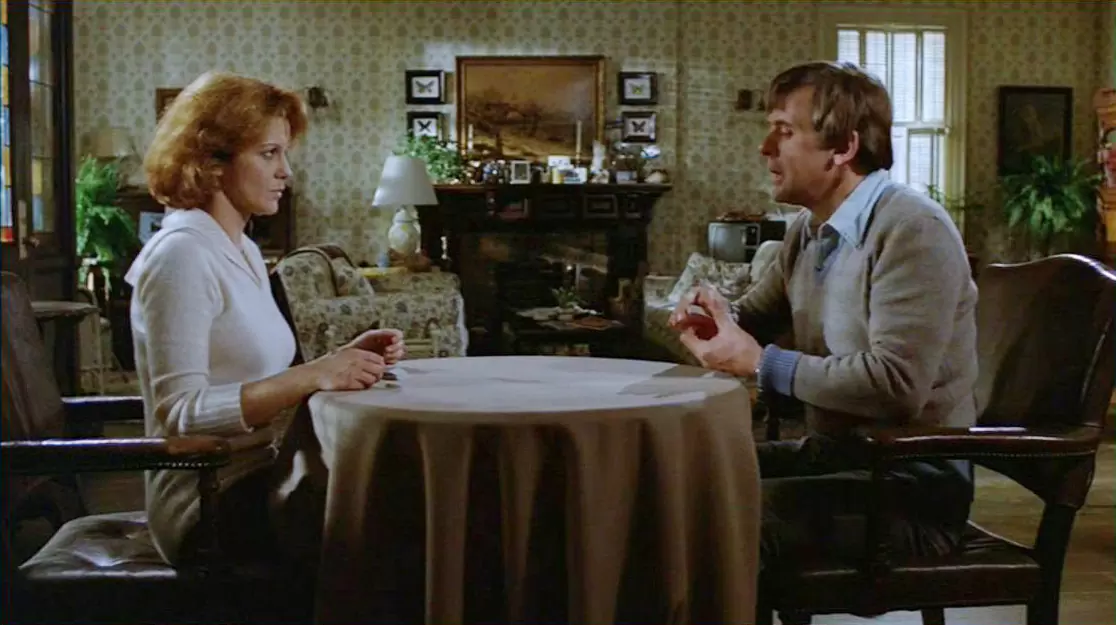
In Richard Attenborough’s film, you will not find a diabolical, fully armed—or at least toothily armed—puppet springing unexpectedly from a wardrobe. Instead, his cinematic tale abounds in suspense, an atmosphere of the uncanny, and carefully calibrated tension. The director’s efforts are effectively supported by Jerry Goldsmith’s score (known, among other things, for composing the soundtracks to the classic horrors The Omen and Poltergeist).
What sets Fats apart from other demonic film dolls? Many things. He does not move, and yet there is something sinister about him. Precisely that stillness activates the imagination. Magic offers viewers a different kind of dread—one based on anticipation, uncanny auditory experiences (after all, one hears the echo of Fats’s distant voice or his muffled speech when he lies at the bottom of a closed suitcase—no skilled ventriloquist could imitate that), ambiguity, and psychological drama. The director also plays on humanity’s need for metaphysics, belief in transcendence—something beyond rationality.
We observe this in Corky’s relationship with his beloved Peggy, as well as his attitude toward Fats. We all want to believe in true love, soulmates, telepathy, magic…

Attenborough’s work is an intimate film charged with deep emotion. For me personally, Hopkins outclasses his namesake Anthony Perkins (famous for Norman Bates). The analogy is no accident, as you will see when you watch Magic (for I assume everyone has seen Psycho).
Corky’s portrayal is a showcase of Hopkins’s talent—after all, it is not easy to convey every shade of emotion with voice alone.
Although the film was quite successful in its time—the author of the novel and screenplay was honored in 1979 with the Edgar Allan Poe Award, and Anthony Hopkins received Golden Globe and BAFTA nominations for his role as Corky—today it is a forgotten work. Even remembering that Attenborough’s film is an adaptation of a novel, it is nonetheless hard to shake the impression that the director and his team were inspired by something more. I refer to the 1945 black-and-white film Dead of Night—a Gothic-style horror anthology. In it, characters gather in a fashion reminiscent of those once assembled at Villa Diodati, sharing mysterious tales full of inexplicable phenomena and dread. One of the film’s novellas recounts the story of a puppet named Hugo belonging to a popular ventriloquist.

The final segment of Dead of Night poses the same questions and exposes the same motifs as Attenborough’s later film.
And who knows—perhaps as he prepared for his role in Magic, Hopkins studied Michael Redgrave’s masterful performance…


LUCIA’S GRACE. Resembles a Kind Of Missionary Endeavor

DOKUMENT. Short Film That Feels Monumental

BEAUTIFUL BOY. The Acting is Remarkable [REVIEW]

Looking Back at SPIDER: More Terrifying Than Horror
