
Movies Explained
5 Reasons to Watch BOJACK HORSEMAN (If You Still Haven’t)
Jokes, wordplay, and subtle, witty allusions counterbalance the serious, timely issues tackled by BoJack Horseman, but they never belittle or diminish them.


Although BoJack Horseman ended years ago, as one can see, it is still hard to forget. This comes as no surprise—it is undoubtedly one of Netflix’s best, most original, and most engaging productions, gathering a huge audience of viewers and fans. Each subsequent season (there were six) delivered a new set of experiences at the highest emotional throttle. From laughter through sadness and tears to a sense of life’s disintegration—this series offered everything at once. If you have not yet been won over by Raphael Bob-Waksberg’s creation, or if you began watching but stopped after a few episodes or seasons, now is the time to correct that mistake.
The following five reasons will convince you to devote time to a certain anthropomorphic horse struggling with depression.
Absurdly original world

A colorful, sun-soaked Los Angeles inhabited by an eccentric mix of humans and anthropomorphic animals who, though living in a typically human society, have not abandoned their animal habits and instincts. The concept alone brings a smile to the lips.
This curiously peculiar world carries numerous playful puns, hidden jokes, and easter eggs that form the series’ hallmark. Every frame is a tableau in which countless witty references to culture, art, literature, and pop culture—films and television especially—are cleverly concealed.
Moreover, BoJack Horseman’s vivid world expands season by season, unveiling ever newer absurd animal-human inventions. Few shows offer such a rare combination of smart, culture-based humor and carefree absurdity—such as a cow waitress serving patrons bloody steaks at a bar.
It stays with you long after

BoJack Horseman is not a series to watch, tick off a list, and forget. It lodges in the memory long afterward, nestling in the realm of emotions that have been upended during viewing.
The most enduring pillars of the series—and the strongest bond between BoJack Horseman and the viewer—are the characters: psychologically credible, beset by real and convincing problems; it is impossible not to identify with them, despite their animal masks or cartoon animation. They sometimes serve as mirrors in which we fear to see ourselves.
The creators ensured that characters such as BoJack, Diane, Princess Carolyn, Todd, and Mr. Peanutbutter possess multidimensional portraits and deep personalities—and, most importantly, do not remain static.
Each season confronts them with new challenges and old and new demons, so that they undergo constant growth. Thanks to the bonds formed between them and the audience, it is truly difficult to tear oneself away from the series—and equally hard to forget; each subsequent rewatch enriches one with new experiences and insights. Such dynamic storytelling and adaptive characters make one genuinely curious about what will happen in future episodes and which paths our favorite characters will take.
It addresses current issues
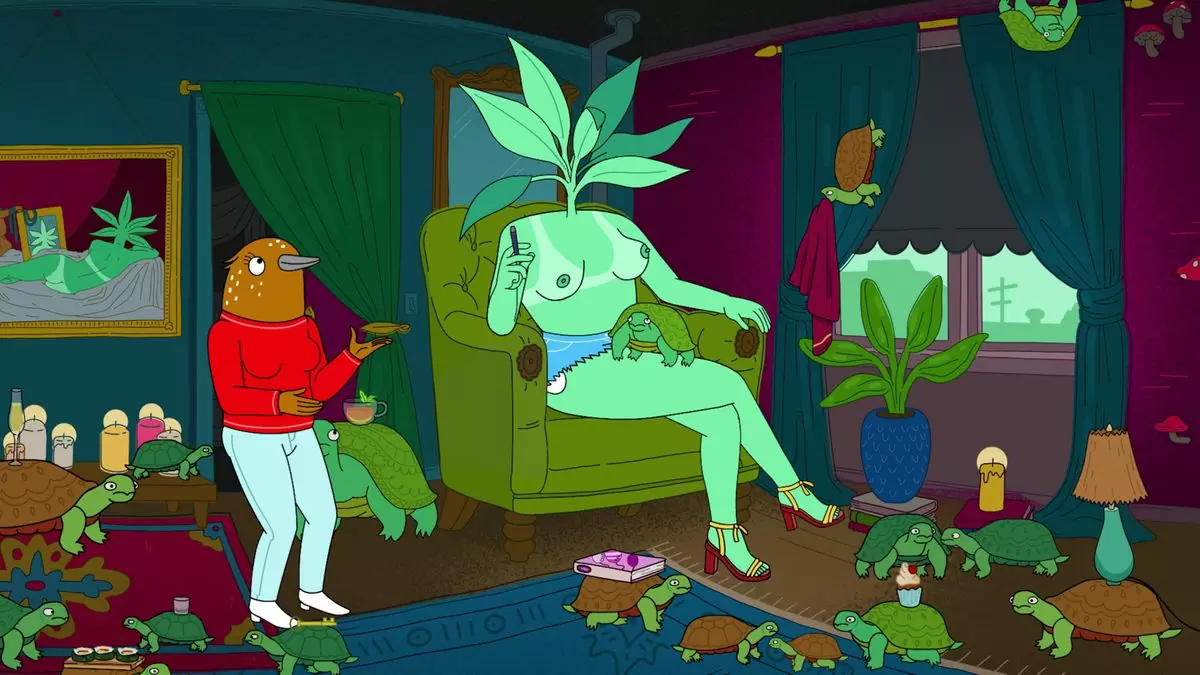
Are we going too far with the idea of choice for women? Today we host a diverse panel of white experts in bow ties to discuss abortion. The series refers to contemporary social issues in an absurdly funny yet still accurate and thoughtful way. An entire episode devoted to the moral questions surrounding abortion—whence the above quote—proves this. Or the one in which Diane wages brutal war on beloved television star Hank Hippopopalous, accused of harassing women.
Or the one in which Princess Carolyn decides to raise an adopted child on her own, or the one in which Todd confronts his asexuality head-on.

Topics revolving around feminism, women’s rights, #MeToo, but also self-acceptance, ubiquitous social media, journalistic prejudice, and the toxic culture of celebrity return like a boomerang, sometimes providing fertile ground for jokes. These jokes—based largely on mocking absurdities, exposing absurdities, or exaggeration—are nonetheless far from arrogance or trivialization. BoJack Horseman offers an interesting view of our contemporary world encapsulated in a vivid caricature, in a distorted mirror.
It honestly confronts mental health

Although the creators depict the life journeys and obstacles of each major character, the title horse consistently receives the most attention, undergoing emotional vivisection before the viewer’s eyes over six seasons. From season to season BoJack Horseman is stripped of layer after layer of shame, life grievances, and failures, providing an excellent psychological study of a convincingly crafted character burdened by existential problems, addictions, depression, and the weight of a troubled childhood carried on his fifty-year-old shoulders.
BoJack is a character of extremes—a conceited egocentric and egoist in whom a spark yearning for change and inner metamorphosis fiercely attempts to break through tangled layers of nihilism.
The creators depict living with depression with the honesty and insight of psychoanalysts. One of the best episodes portraying depression unflinchingly is Walking Shame. Shame. A walking shame. I am a fucking walking shame. I know I am shame, unlike the rest of the shames, begins the episode. Its leitmotif is BoJack’s internal monologue, whose castigating thoughts are illustrated in a two-dimensional, somewhat grotesque animation.
The same device is used two seasons later in Good Destruction.

When Diane stops her antidepressants, haunting, guilt-laden thoughts plague her onscreen in similarly nightmarishly psychedelic animation. You blame everyone for your problems, yet you never change yourself, cries one of the accusing voices. BoJack’s creators—Raphael Bob-Waksberg and illustrator Lisa Hanawalt—portray depression in an extraordinarily vivid, credible, and honest way.
But the show does not stop at accurate depiction: BoJack Horseman is the series that, like no other, shows how to cope with life’s problems, shake off the muck of existence, and refuse to be stuck in stagnation.
It balances drama and comedy
Even considering everything noted above, BoJack Horseman remains a series that deftly wields both comedy and drama, absurdity and pathos. Its eccentric humor lends it lightness, so the viewer does not feel overwhelmed by the depression that sometimes emanates from the screen.
The show essentially consists of two realms—absurdly funny animation and depressingly somber existential drama—that might seem utterly mismatched. Yet neither dominates the other. Comedy and drama in BoJack complement each other harmoniously, creating a thoughtful series in a comedic-absurd sauce.

Jokes, wordplay, and subtle, witty allusions counterbalance the serious, timely issues tackled by Raphael Bob-Waksberg, but they never belittle or diminish them—both layers coexist in perfect symbiosis. A prime example is the character of Todd Chavez—his wild adventures, born outside the bounds of logical thought and worthy of a spin-off, serve as a marvelous embellishment and complement to the series. Watching this Netflix production, one may begin to rethink the definition of happiness, question the level of life satisfaction—but one can also simply enjoy a well-written, creatively realized series with abundant humor, and those two experiences by no means exclude each other.


LUCIA’S GRACE. Resembles a Kind Of Missionary Endeavor

DOKUMENT. Short Film That Feels Monumental

BEAUTIFUL BOY. The Acting is Remarkable [REVIEW]

Looking Back at SPIDER: More Terrifying Than Horror
