
Features
M Explained: Fritz Lang’s Shockingly Relevant Masterpiece
I dare say that if someone were to show M to today’s audience unfamiliar with its existence and claim it was a film made last year, many would buy that story.


The reasons for people’s attraction to this hypocritical ideology were, as always, the same—an escalating economic crisis, hunger creeping into the pots of an ever-growing number of citizens, declining living standards, and the ineptitude of the ruling parties. German intellectuals, artists, and politicians were aware of the gravity of the situation. The specter of Nazism began casting a shadow over a hopeful future. Nevertheless, most opponents of the Hitler camp did not attempt, even ideologically, to mount a broader fight. The more common phenomenon was a silent rebellion—an internal revolt against something that could not be stopped. M
Fritz Lang was one of Adolf Hitler’s quiet opponents. Lang’s opposition to the totalitarian state is clearly, albeit subtly, highlighted in his last two films made in pre-war Germany: M and The Testament of Dr. Mabuse. Chronologically, M was made in 1931, and the second part of the Mabuse saga premiered in 1933. It had to disappear from cinema screens shortly after its release due to its “incompatibility with the doctrine of National Socialism.” After this event, and after rejecting Goebbels’ offer (the Minister of Propaganda and Public Enlightenment saw a place for Lang in German cinema, ignoring the fact that Lang had Jewish roots), Lang left the Third Reich, leaving behind his wife and screenwriter Thea von Harbou, who had become obsessed with Nazi doctrine.
This brief overview of the atmosphere surrounding the last two German films of Fritz Lang seemed necessary, in my opinion, to begin discussing his penultimate step and, in hindsight, perhaps the most decisive one (alongside Destiny) in the entire filmography of the German master—M.

M and German Expressionism in Cinema
Most film-related websites, not to mention the opinions of their users, claim with great pathos that M is the pinnacle of expressionist cinema—a kind of apogee of those fertile ten years of interwar German cinematography.
I believe that such a carefree approach, devoid of any critical perspective on Lang’s film, is simply an infantile repetition of a slogan likely found on a poster or advertisement promoting a film that, in reality, needs no promotion. Even less understandable to me are attempts to compare it with films like Metropolis (Lang’s most popular film), The Cabinet of Dr. Caligari (the cornerstone of expressionism created by Robert Wiene), or any other strictly expressionist film from the 1920s and 1930s. Unfortunately, we must call it by its name—this is sheer ignorance on the part of those writing about M.

Fritz Lang never adhered to the extreme formal expression initiated by the story of the somnambulist. Predatory building shapes, leafless trees distorted by a fantastical wind, and crazy worlds painted on canvases stretched between scaffolds in dark studios are elements we search for in vain in his German filmography. The closest film of Lang’s to Caligarism is probably Metropolis with its image of the city—a machine—and its people—soulless components in the background. This is not only because of the futuristic décor but also due to the extremely strong, almost naive contrast of white and black, where the former, of course, signifies goodness and mental clarity, and the latter, poverty, evil, and ignorance.
Similar insinuations can be found in his Nibelungs, although the sharp color contrast there appears only in relation to one character—the cruel murderer Hagen. M is far from the formal extravagances of Caligarism, which—let’s make this clear—many mistakenly consider the only legitimate form of expressionism. On the contrary, M is formally stripped to a minimum, which does not mean it is devoid of formal virtuosity. This virtuosity manifests itself in individual scenes and shots, but it doesn’t jump off the screen like the fantastic, yet mad worlds of films à la Robert Wiene. In terms of aesthetics, M resembles Destiny, stripped of Méliès-like tricks, but there is once again a chasm between them in terms of content.

While Lang’s first film chronologically transports us to a semi-fantastic world—a reality in which Death can descend to Earth and test a truly loving woman—the story of a child murderer strikes with its realism. There is no place for fairies, golems, vampires, flying carpets, or Grim Reapers with big hearts. German folklore and the significant romanticism characteristic of expressionism fade away. Its remnants can only be glimpsed in the character of Hans Beckert, the titular murderer. He is, after all, a figure who hides a cruel secret behind an unassuming appearance—a man who is insane and torn by undefined forces that compel him to commit more murders. Despite his clear disgust for himself, he cannot stop the machinery of crime once set in motion.
By harming others, he harms himself. A clear atomization of the hero’s mind is visible. The result is the emergence of two seemingly autonomous figures—the ruthless murderer and the clumsy victim of the wild desires of the former. This approach to man as a beast lulled to sleep by social norms is particularly close to expressionism.

It would be entirely unrealistic, in classical expressionism, to place criminals, police officers, and ordinary citizens on the same level. Just a few years earlier, Hans Beckert would probably have been depicted as a deathly pale madman with sunken eyes, wrapped in a jet-black coat that covered nearly every part of his body. In M, he looks like a clumsy citizen running out to buy fresh rolls for breakfast. Moreover, during the film, one of the criminals points out that the child murderer won’t look like a fairy-tale monster but, quite the opposite—“he could be a nice guy who plays marbles with the kids with a smile on his face.” The criminals and the police not only look very similar but also act based on similar logic—the logic of gain.
The police are not keen on public opinion seeing their weakness (their inability to catch a serial killer). The criminals decide to take matters into their own hands because the increased police activity interferes with their work. Thus ends the era of clear value judgments emphasized by the contrast of black and white. The society in M is the result of these colors—everyone is gray and inclined toward both good and evil. This is far from expressionism, unless we stretch the whole argument to Hans’s character (the fragmentation of the mind, the inherent schizophrenia in the style of Dr. Jekyll and Mr. Hyde). In terms of content, M is far removed from most expressionist films that were successful enough to remain in the memory of some moviegoers.

The same goes for its form, which—like its content—is closer to Kammerspiel than German expressionism. Kammerspiel stood in opposition to the extreme unreality of films from the first half of the 1920s, focusing on depicting real life and real people. Thick smoke or fog, often playing a significant role in the story of the murderer, also brings it closer to the delicate imagery of Kammerspiel, distancing itself from the predatory contrasts of the “mad expressionists.”
On the other hand, drawing a clear, thick line between M and expressionism or M and Kammerspiel is not, and never will be, possible. This film draws inspiration from both of these different currents to create an innovative whole.
That’s why I believe that M should not be naively seen as the apogee of expressionism. Lang surpassed any straightforward critical classifications with it. If it is the pinnacle of anything, it must be the pinnacle of itself—the pinnacle of M, as idiotic as that may sound.
Circumstances of Creation
Lang’s film appeared in German cinemas in May 1931. Just two months later, Peter Kürten, known as the “Vampire of Düsseldorf,” was sentenced to death for nine murders and seven attempted murders. It is certain that Kürten’s criminal spree took more victims. Until his execution, Kürten showed no remorse or regret for the fate of the families of the brutally murdered victims. Conversations conducted by forensic psychiatrist Karl Berg revealed that Kürten derived sexual pleasure from his brutal murders.
He was particularly aroused by the sight of his victims’ blood (including that of young children). During his attacks, he also committed rape several times. Like many serial killers, he toyed with the authorities and public opinion by sending letters to popular newspapers. The police department announced a large monetary reward for his capture and even called for help from organized crime groups. Ultimately, Kürten was betrayed by his own wife, remarkably at his own request. One of his victims, a young woman, survived the attack and identified Kürten’s residence. Cornered, Kürten asked his wife to testify against him, motivated by the desire to ensure her a decent life after his death.

The analogies to M are obvious at first glance, yet—for reasons unknown—Lang opposed the idea throughout his life that Hans Beckert’s story was a film adaptation of the Vampire of Düsseldorf. Even the working title of M clearly hints at Kürten’s case. The murderer is among us (M – Mörder unter uns). The phrase was taken directly from a public announcement regarding the reward for capturing the serial killer, which Lang must have known about given the case’s widespread publicity.
Society, panicked by Kürten’s increasingly brutal crimes, began a full-fledged witch hunt, albeit in a more democratic form. Instead of using paper to start bonfires, people used it to write anonymous tips to the police.
The number of leads collected by the police reportedly exceeded ten thousand. The reaction to this can be seen in one police officer’s refusal to release certain facts to the press, stating that it would only lead to more baseless tips. In a society gripped by hysteria, it became easier to lynch random passersby (a scene in which an innocent old man is almost lynched in M closely reflects this reality). The public mood was so frenzied that many people believed the killer lived within them (nearly two hundred cases were recorded). There is also a parallel between Hans’s “fondness” for children, especially little girls, who become the victims of brutal murders in the film. The film’s murderer, like Kürten, writes a letter to the press using a thick red pencil.
Records show that Kürten’s letters to the press were written with a thick blue pencil. The final similarity is the fate of the villain—poena capitalis, or capital punishment, suggested but not shown in Lang’s film.

A decisive fact proving Lang and Thea von Harbou’s awareness of Kürten’s case is the research they did before starting M. While it might be believable that an average person, distant from the epicenter of the crimes, not reading newspapers or caring about criminal matters, could have missed the series of murders—though even that is difficult to accept given that Lang was not locked in isolation—it would be an abuse of trust to accept Lang’s claim that he was not inspired by Kürten’s case, especially when he and his wife carefully gathered information about all sorts of deviants by reading reports and interviewing forensic psychiatrists. Thus, M is certainly inspired by events in Düsseldorf, though not only by those. In the 1920s, there were three other infamous child killers: Haarmann, Denke, and Großmann.
However, I emphasize the word “inspired” in the first sentence of this paragraph. Lang used the facts he learned to build a film that has a completely different central point than the newspaper reports or stories about bloody murders. It seems the events in M are merely a pretext for the final two scenes: the basement trial and the legal trial. A pretext for discussing the justification of the death penalty, or perhaps more precisely, the righteousness of claiming the right to decide who is human and who has symbolically died, becoming human trash—a soulless beast.
The Enduring Relevance of M
The question of “crime and punishment” still hovers over the gray streets of an unnamed German city. And most importantly, for understanding the phenomenon of M: the question posed by Lang nearly eighty years ago—long before the demons of World War I and World War II—remains just as relevant in our era of globalization and commercialization. Lang delicately captured nearly all the “for” and “against” arguments raised by modern abolitionists and retentionists. In the following paragraphs, I will not claim the right to make a definitive judgment on the described situations. Instead of offering a final verdict, I will pose rhetorical questions.

Let us begin by analyzing the character of the serial killer, likely also a rapist and pedophile (stating this explicitly would not be in the style of the German director), since the potential death penalty would concern him—Hans Beckert. Lang from the beginning portrays him as a calm fellow who is perpetually amazed by the world around him, with unrealistically large and deep eyes. The problem begins when a characteristic whistle starts coming out of Hans’s thin lips (imitating the tune of In the Hall of the Mountain King, composed by Edvard Grieg for Ibsen’s drama Peer Gynt). The melody, which accompanied Ibsen’s hero as he fled from hostile mountain creatures, signals the worst in M—the awakening of Hans’s evil nature, a murderer who takes pleasure in killing innocent, naive children.
In the murderer’s eyes, we see helplessness and panic on a platter. The best illustration of this is the scene where Hans walks down the street, whistling the tune. Suddenly, he speeds up and, like a madman, runs into the nearest bar/restaurant with no idea what to order. Finally, after a series of nervous changes in decision about what he wants, he orders a shot of something stronger. The melody gets faster—he tries to drown it out, he tries to fight it, but as we know, it’s all in vain (the “other” is stronger).

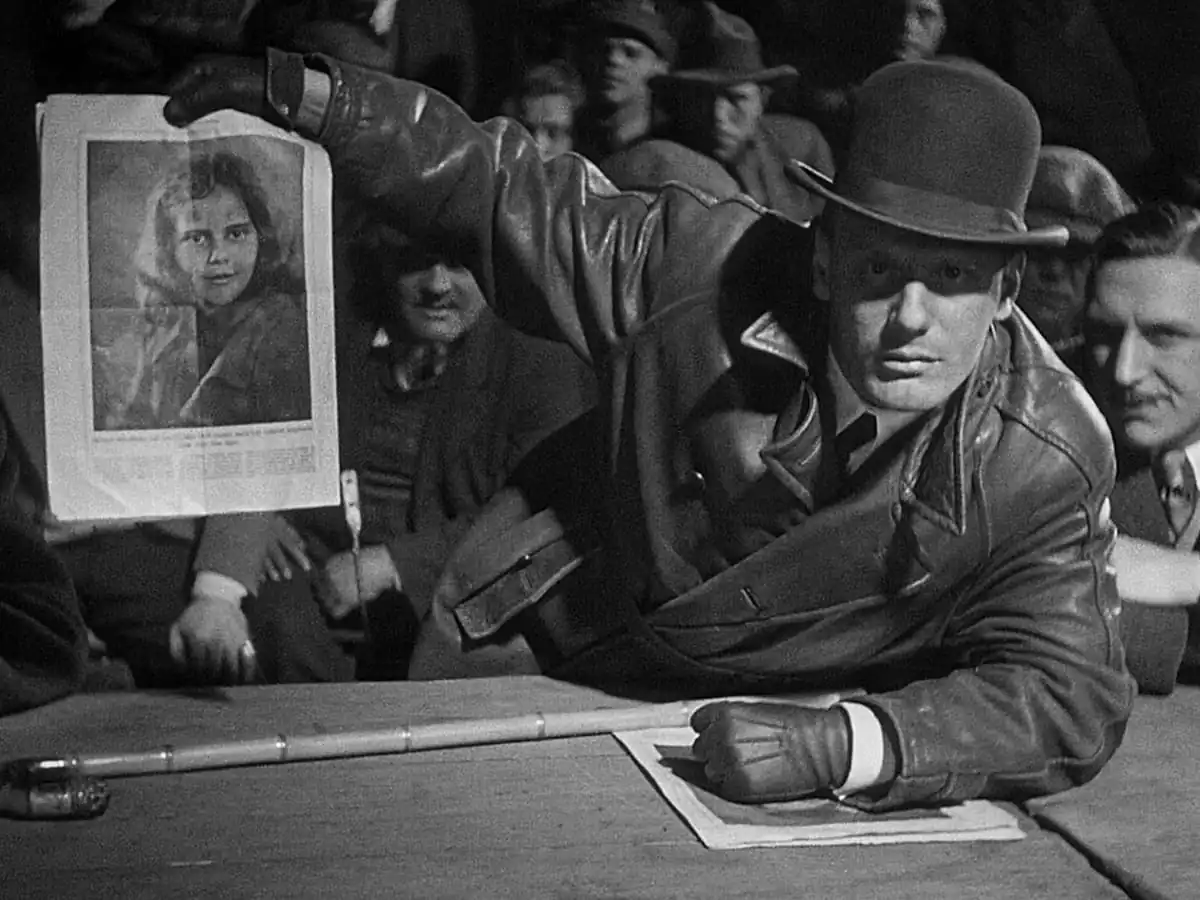
The hyperbole of this already expressive fragment comes in the next two scenes: the chase in the abandoned building and the trial of Hans by local criminals and the victims’ families. The first scene perfectly illustrates the fear that accompanies the life of a murderer, the fear of being exposed, completely contrary to the psychological profiles of serial killers. We can understand that this man is not another emotionless deviant who doesn’t comprehend the seriousness of his actions. The next scene tells us even more about him. During his crimes, Hans falls into a frenzy, causing him to forget the crime afterward. He learns about the horrifying nature of his outings from newspaper headlines and posters offering a reward for his head.
As if that weren’t enough, he falls to his knees and sincerely (it’s obvious) expresses his internal tragedy, his inability to control his sick urges. “You don’t know what it’s like,” he says, and he’s probably right, we don’t.
In summary, Hans is a normal man in his day-to-day life, keeping away from high society and crowded cafes. He doesn’t stand out, doesn’t seek cheap thrills, and avoids trouble. Against his will, something sometimes awakens in him (let’s call it using religious terminology) a “demon” commanding him to kidnap and murder children. He first pampers them with sweets, balloons, and toys, taking advantage of their trust and naivety to fulfill his wild desires.
However, he doesn’t remember the act of killing itself. It seems that his memory is wiped clean from the moment he starts whistling to the moment he falls asleep after the act of aggression. After returning to his “normal” state—the state before falling into one of those murderous frenzies—Hans sincerely regrets his actions and is terrified at the mere thought that soon Grieg’s notes will once again escape his lips. Do we have the right to judge Jekyll for Hyde’s bloody escapades, especially considering that Hans did not experiment with drugs to create his own Hyde?

The last sentence of the previous paragraph raises a question of enormous importance in the debate between abolitionists and retentionists—“Do we have the right to judge?” Lang’s film asks it masterfully—there’s no other word for it. In this respect, M is simply a masterpiece. We need only focus on the social trial scene, which takes place in a dark, dirty, forgotten basement, the kind found in every major city. We’ve already mentioned Hans’s “confession,” made during this segment of Lang’s film. But we must also note that sitting in judgment over the murderer are people who have themselves killed or sinned multiple times. People devoid of judicial office—unquestionable criminals, shady characters, but also mothers of murdered children staring at their tormentor in pain.
The questions Lang asks directly pierce through the dust-laden basement air of this unusual courtroom. Can a person claim the right to decide the life of another when they themselves are not perfect, and perfect people do not exist and never will? And perhaps more importantly, is the very institution of court sometimes an illusion that allows us to silence our conscience? Let’s note that no lynching—no bloody mob justice—took place. Instead, a makeshift trial was organized with remarkable speed. Why, when the outcome was clear from the beginning? After all, one of the first lines in the trial was: “We do not intend to keep you in prison on our hard-earned money.”
The scene that sums up M, and in my view is key to understanding Fritz Lang and Thea von Harbou’s position, is the brief snippet of the official trial, or rather, the reaction of one of the mothers after hearing the sentence, which we viewers can only speculate about. The tearful woman, clothed in mourning, says (as if to herself) that what happened just moments ago in the massive courtroom, carved from some noble wood, will not bring her children back. What was the point of it all?

The suggestiveness of this scene makes me believe that Hans received a death sentence, postponed by the police’s intervention during the basement trial. And it seems that Lang put his own feelings about the death penalty into the grieving mother’s mouth. Why, since we cannot restore life, should we take another? On the other hand, can the life of a murderer balance the scales if, on the other side, lies the life of his innocent victim? Lang’s ambivalence may also explain his repeated claims that real events (especially Kürten’s case) did not influence the story presented in M. While Hans Beckert may evoke sympathy from the audience, a ruthless murderer, rapist, and deviant drinking the blood of his victims could not gain any public sympathy.
Perhaps Lang simply did not want society to think that their great director was defending someone like Kürten?
M and Formal Revolution
Playing with Expressionist Fetishes…
…and particularly the recurring motif of the shadow as an almost autonomous entity. While in early expressionist films based on Caligarist aesthetics, the shadow detached from what cast it, occupying large canvases crowded into cramped film studios, in the later phase of the movement (mainly thanks to Murnau and Lang himself), it was given life. Recall the vampire creeping toward his victim and the perspective from which this approach was filmed. In the early stages of the shot, we do not see the character (which, for those times, was unusual), but rather a well-lit wall where the huge shadow of the night visitor appears.
The black blot cast by him on the wall becomes more terrifying for a moment than he himself. Similar techniques can be seen in other Murnau films, like Faust, and in Lang’s works (for instance, Destiny or Metropolis—a sort of city of shadows). In M, the shadow gains another property—it starts to speak. At one point, it replaces the protagonist (in the scene where Hans’s face casts a shadow on a wanted poster). Thus, the shadow becomes an autonomous entity—something it had aspired to throughout the movement’s existence.
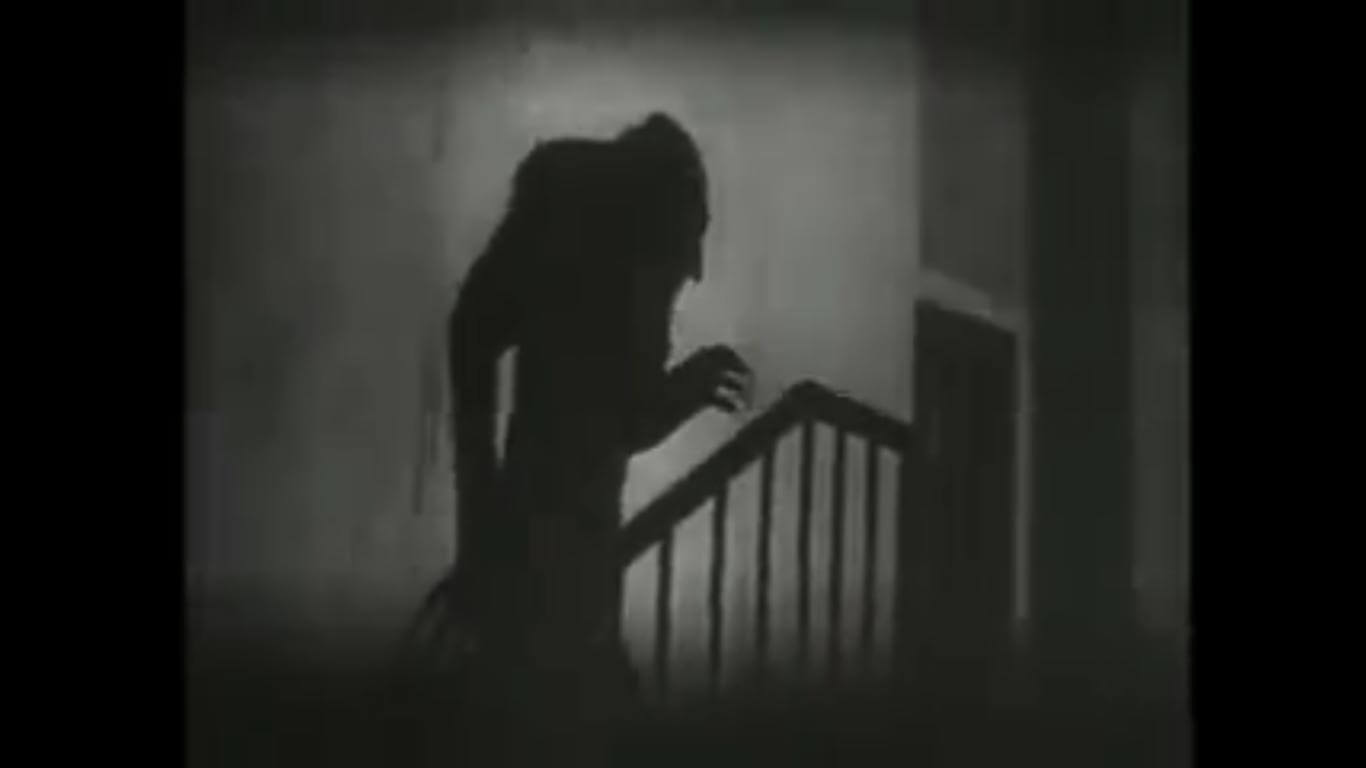
Max Shreck in Nosferatu by F.W. Murnau
Revaluations…
…the most important of which is the previously mentioned revaluation of the dichotomous model of the world, proposed by expressionist cinema for almost its entire duration. In M, we do not have good people and bad people. Those dressed in white in bright rooms, and those dressed in black rags, huddled in equally black dwellings. In Lang’s world, everyone seems equal—a bit bad and black, and a bit good and white. The director looks at the world from a completely different perspective than the one that prevailed just a few years earlier.
The same can be said about the figure of the murderer himself. Peter Lorre’s appearance—those teary eyes and remorse for his sins—would make him a positive character in most expressionist films. Lang avoids painting another madman with corpse-like skin and black eyes contrasting with unnatural skin brightness, a madman laughing maniacally at his actions, plotting great crimes against humanity. Finally, he also strips the character of fantastic dimensions. Hans cannot be seen as a legendary hero—a symbol drawn from folklore. He is a flesh-and-blood human being, as the film’s working title says—“someone who lives among us.”
Masterful Sound Design…
…despite M being Lang’s first sound film. While most sound films produced shortly after the invention of sound used music and voices to crudely illustrate events on the silver screen, Lang immediately reached the level of today’s productions. He instantly understood that sound could not be just an addition—it could become an equal element of the film, influencing its reception as much as the image.
To illustrate what I mean, a few short scenes suffice. The first takes place in Elsie’s house—the girl abducted by Hans. We see her mother preparing a meal.
Suddenly, the clock strikes the hour, and the bells chime—the mother smiles, knowing her daughter has just finished school. Unfortunately, her return is delayed. The mother begins to worry, and the sounds fade and fade until we hear nothing. Then the mother rushes to the window, calling her daughter loudly and with growing distress. Lang shows us the empty staircase, the empty attic, and the empty meadow. When the action moves outdoors, her shouts fade. In complete silence, we watch the balloon Hans bought for Elsie get caught on power lines…
The second scene connects two distant places. Visually, we are in Hans’s house, but the sounds come from the police station. A policeman provides a psychological profile of the murderer, emphasizing that he is surely an ordinary citizen. Hans watches himself in the mirror with horror, nervously touching his face as if he hears the officer describing him.

Throughout the film, Lang frequently contrasts scenes full of noise (street hustle and bustle) with completely silent ones. He understands that silence can sometimes say much more than noise. Finally, we must mention how the beggars expose the murderer—the blind man recognizes the melody Hans whistles while buying a balloon for Elsie. Sight failed, but sound solved the case—a symbolic nod from the old medium to its modified version.
A Few Words in Conclusion
Despite the passage of time, M has not lost any of its value, let alone its relevance. Just consider the emotions sparked by films addressing the death penalty, such as The Green Mile, Dancer in the Dark, or Dead Man Walking.
Look at how much controversy arose around the execution of Saddam Hussein, an undoubtedly guilty criminal. Examples are not hard to find. Consider the case of the W. brothers, responsible for lynching a recidivist who endangered the lives of villagers. According to the letter of the law, they should be convicted of premeditated murder, but the people see them as local heroes. The same issues arose in M—does the life of a criminal equal the life of his victims? Is the judgment of those wronged more natural than the judgment of bureaucrats? And why should we pay money to keep a repeat offender in prison (if the brothers had not taken matters into their own hands)?

The topicality of the themes matches the relevance of the form. I dare say that if someone were to show M to an audience unfamiliar with its existence and claim it was an independent film made in contemporary times, many people would buy that story. There’s no theatrical acting typical of silent films, the relationship between sound and image is as we know it from today’s films, and the topic remains relevant and emotionally charged—what more could you want?


LUCIA’S GRACE. Resembles a Kind Of Missionary Endeavor

DOKUMENT. Short Film That Feels Monumental

BEAUTIFUL BOY. The Acting is Remarkable [REVIEW]

Looking Back at SPIDER: More Terrifying Than Horror
