
Horror Movies
DAWN OF THE DEAD: Zack Snyder’s Excellent Zombie Debut
Dawn of the Dead is solid cinema that does not diminish the legacy of Romero’s classic living dead, and… Tom Savini makes a cameo.


When there is no more room in hell… The dead will walk the earth.
We live in an age of endless continuations, remakes, sequels, and the commercial exploitation of established, box-office titles, where the idea of creating a new version of film X that would be better than the original in any way other than “better production values” or a title upgraded to New X seems impossible. Whenever a classic film is brought back to the screen, it is done differently now, in new settings, with a different tone. Often the remake lacks the freshness and magic of the original. Its atmosphere disappears, and any deviations from the original screenplay are viewed as a cardinal directorial sin. Dawn of the Dead
Yet rigidly adhering to clichés from the original does not always serve a remake well.
Gus Van Sant, for example, remade Hitchcock’s Psycho by doing a shot-for-shot copy. Essentially Psycho is nothing more than a repetition of Hitchcock’s frames, shots, and scenes—only in color and with different actors. What came of it? Nothing good. Likewise, the new version of Vanishing Point, and many, many others disappointed viewers. The power of both those films lay in their atmosphere and tone, which simply could not be copied or repeated.

One can nonetheless say that all these new versions or remakes are practically tailor-made for older films that need a contemporary technological (special effects), cultural, or regional facelift. This applies to classics such as the Japanese Seven Samurai and Ringu, the French Nikita and Les Visiteurs. Of course, a change of setting does not always benefit an old story transplanted into new circumstances, but Americans persistently practice making their own versions of high-profile foreign titles.
In this mill called Let’s make a new version! it is truly hard today to find a good film.
Zombie films, however, have exceptional luck with remakes. In 1990, Tom Savini directed a new version of the cult, universally acclaimed horror Night of the Living Dead (1968) by George A. Romero. The new Night of the Living Dead was shot, of course, in color, and the original’s shocking ending was replaced with a slightly different, somewhat less surprising and tragic but still interesting finale.
Overall, Tom Savini’s remake maintained a high standard and did not rely solely on the original’s popularity.

The same happened with the remake of Romero’s 1978 film Dawn of the Dead, which we will now discuss.
The director’s chair was occupied by a complete novice, Zack Snyder, for whom Dawn of the Dead was his directorial first time. My surprise was all the greater at the rather high quality of Snyder’s version. First and foremost, the director deserves great applause for the outstanding prologue and the fantastically shot street scenes (beautiful camera moves!) where zombies pursue the (still) living. Snyder presents all of this with extraordinary genre awareness, dynamism, and vivacity—if that word can even describe a film about zombies.
After a while, the action naturally shifts to the Supermarket (I say naturally because in the original Dawn of the Dead the entire story takes place in an abandoned supermarket), which becomes the arena for most of the events. Here the group of survivors forms, ready to stand shoulder to shoulder against the zombie hordes. Among the handful of protagonists, Ana (Sarah Polley), Officer Kenneth (Ving Rhames), and Michael (Jake Weber) come to the fore. There is also CJ, who plays a significant role in the fight against the living dead, and a couple expecting a child (more on them later).
Zack Snyder and one and only James Gunn (the screenwriter) also added one quite intriguing character—a solitary gun-shop owner (!), who sits on the roof of a building several dozen meters from the supermarket.

This setup created a perfect scenario for a few gags and dramatic payoffs. Of course, this is not the only change introduced in the new Dawn…, nor is it the most important one.
The filmmakers first and foremost altered the positive protagonists, endowing them with singular, distinctive traits and unconventional personalities. They also changed the way zombies move, giving them such speed that it is hard to escape even a single one. That speed on one hand gave the zombies more terrifying qualities, but on the other hand somewhat spoiled Romero’s classic zombie image, making them resemble the “infected maniacs” of Danny Boyle’s 28 Days Later.
We should recall that in the 1978 original Dawn…, zombies were only slow, staggering corpses who only posed a lethal threat in large numbers.
The decision to give them speed was surely driven by the spectacle of scenes where zombies chase and overwhelm people, even at the cost of losing some of Romero’s original atmosphere. But let us assume that Zombies A.D. 2004 simply had to have fast zombies because… we live in such times, and that is how our zombies are. Overall, setting aside for a moment that Dawn of the Dead is a remake and not comparing Snyder’s film to Romero’s, the zombies look terrific and perform marvelously in action.
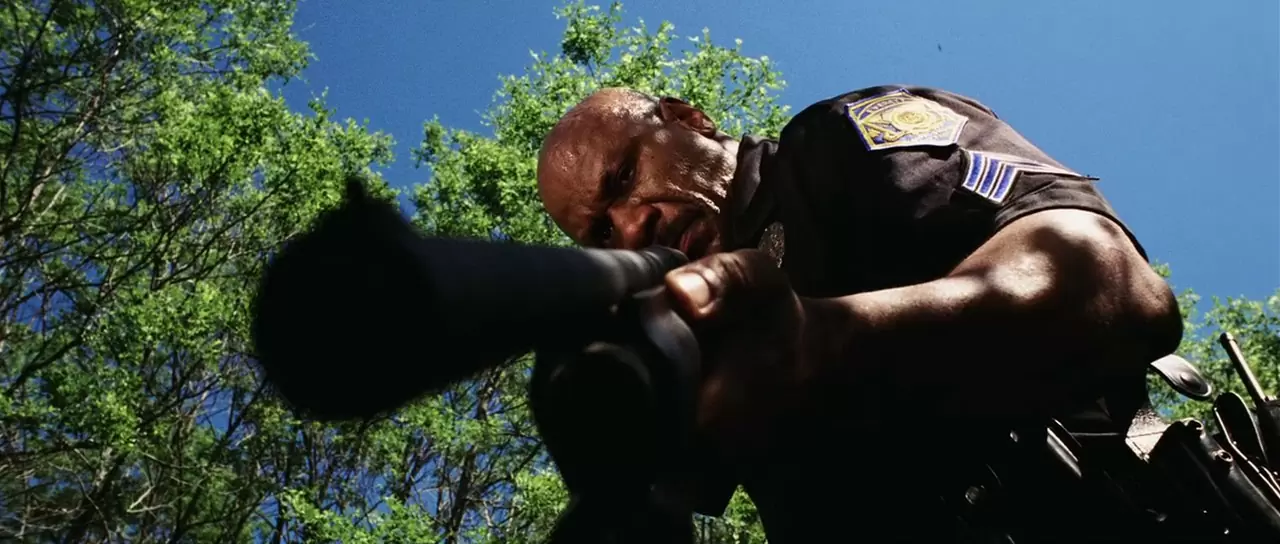
The movie also boasts excellently executed fight sequences against the living dead. The camera work, shot dynamics, and editing are all a solid A plus! Dawn of the Dead also features an unconventional ending, several good humorous scenes, and the fact that the time period remains untouched. What does that mean? It means that despite its modern setting, we never see a cellphone in the survivors’ hands, which enhances the drama and the sense of isolation inside the besieged supermarket. Yet there is no rose without thorns, and no film without flaws. The action in Dawn… develops interestingly and follows a logical cause-and-effect chain, but in a few spots something is off; suddenly we notice that here and there a transitional shot is missing.
For example, a promisingly brutal brawl abruptly cuts away to seeing the characters somewhere else, where the action (the gunfight) is already ending… as if a few shots had been excised. It’s akin to seeing a wound appear on a character’s face that was not there in the previous shot—one wonders where and how that wound materialized. There are quite a few of these “holes” in Dawn…. It looks as though some graphic scenes were cut out. I simply cannot abide a moment when one of the main characters stands in the doorway with a gun, ready to save his friends… and then we see that it is all over, the tension vanishing with the edit between shots. Another major minus is the merciless subplot involving the pregnant woman and everything that entails.
That motif seems to have been (ill-) conceived the worst in the entire screenplay and feels completely out of sync with the otherwise solid film.

Setting aside these rather significant rough edges that jar the viewing experience, Zack Snyder’s Dawn of the Dead is undoubtedly a worthy successor to Romero’s original. The film holds the audience’s interest, there are moments that will make you jump in your seat, and the technical aspects leave no room for complaint. Dawn of the Dead is solid cinema that does not diminish the legacy of Romero’s classic living dead. Finally, I will add that for fans of living-dead cinema there is a fun Easter egg: Tom Savini makes a cameo, but you will surely spot him yourself when watching Snyder’s film—which I wholeheartedly recommend!


LUCIA’S GRACE. Resembles a Kind Of Missionary Endeavor

DOKUMENT. Short Film That Feels Monumental

BEAUTIFUL BOY. The Acting is Remarkable [REVIEW]

Looking Back at SPIDER: More Terrifying Than Horror
