
Article
CREATURE FROM THE BLACK LAGOON. The Last of the Greats
The Creature from the Black Lagoon is the last creature with gothic roots that was truly original and developed entirely new elements within the horror genre.


The venerable grandfather is German Expressionism, with Doctor Caligari and Nosferatu at the forefront, but it was in the United States in the 1930s that the real boom for various kinds of monsters and specters began. Under the baton of producer Carl Laemmle Jr., the studio produced such classic horror films as Dracula (1931), Frankenstein (1931), The Mummy (1932), The Invisible Man (1933), and Bride of Frankenstein (1935).
Universal introduced gothic creatures, fog, old castles, mad scientists, and dark forests to the cinematic scene. Unfortunately, by the 1940s, the formula began to eat itself. Ideas and characters were exploited to the limit – sons and daughters, ghosts, hands, tombs, and even the houses of Dracula and Frankenstein paraded across screens. There were also increasingly strange encounters between monsters – among themselves and, for example, with comedians Bud Abbott and Lou Costello. Eventually, however, the era of classic monsters came to an end with the advent of the 1950s and the breakneck arms race defining the Cold War period.
This shift also ushered in the so-called “atomic era” in horror cinema, during which monsters from folklore and gothic novels had to make way for scientific experiments, mutated insects, and invaders from space aiming to destroy or conquer our planet – or at least, in a grand conspiracy, abduct human bodies. Much of the invasion cinema was a clever warning against the looming red tide of communism over the United States. Yet, even in this peculiar era dominated by B-movies and cheap special effects, there was room for the last monster drawing heavily from the classic legacy while being incredibly original.
Where was it found? In the pristine depths of the Black Lagoon, located in the heart of the Amazon jungle. Creature From the Black Lagoon.

Creature from the Black Lagoon
The idea for the Creature from the Black Lagoon was born in the mind of producer William Alland due to a story he heard in 1941 from Mexican cinematographer Gabriel Figueroa at a party at the home of the legendary Orson Welles. The prototype of the film character supposedly haunted the Amazon basin, where once a year it emerged from the water to abduct a virgin, only to disappear without a trace. The tale of a half-man, half-fish fascinated Alland so much that ten years later, he jotted down his thoughts, titling them The Sea Monster and adding a storyline inspired by Beauty and the Beast.
The final version of the script was created by Harry Essex and Arthur A. Rose, with Jack Arnold – the creator of the most recognizable fantastic spectacles of the 1950s, such as It Came from Outer Space (1953), Tarantula (1955), and The Incredible Shrinking Man (1957) – behind the camera.

Creature from the Black Lagoon
The story of the new celluloid monster begins with a geological expedition discovering a fossilized hand, whose fingers are webbed.
The creature, originating from the Devonian era, is likely the missing link between marine fauna and humans. The scientists, thrilled by their discovery, are unaware that not far from them, another hand of an intriguing creature – this time very much alive – is emerging from the water.

Creature from the Black Lagoon
To assist in the research on the find, ichthyologist David Reed and his girlfriend, Kay Lawrence, are brought in.
A group of scientists sets off to the Black Lagoon to further investigate the discovery that could revolutionize modern science. They do not know, however, that this expedition will lead them to uncover more than they ever expected.
Creature from the Black Lagoon – or Gill-Man, as the characters in the films call him – comes from the Devonian era, when life emerged on land. It is uncertain how old the creature is exactly. It might be the last descendant of a fifteen-million-year-old species or might have survived alone since that epoch. In terms of physical aspects, Gill-Man surpasses the average human, reaching nearly two meters in height (this was the height of actor Ben Chapman, including the monster costume), and weighing around 136 kilograms.
He possesses super strength, allowing him to throw people, break trees, overturn cars, or tear apart chains, and his hands are equipped by nature with razor-sharp claws that pierce human flesh like a knife through butter. He also has the ability to heal quickly, enabling him to survive wounds fatal to humans. Despite all the advantages of aquatic life that have shaped his body, one of the resulting drawbacks is photophobia, making an ordinary flashlight an effective weapon against Gill-Man.

Creature from the Black Lagoon
The monster of Creature From the Black Lagoon has a humanoid silhouette and fish-like facial features (in early designs, he had a much more human appearance, to the point that the creators even described him as handsome), and his body is covered with thick, green scales.
His hands and feet are webbed, forming something akin to fins. He also has gills, allowing him to stay on land for only a short time – this will be changed in the third part of his adventures, revealing that he also has lungs, and hidden under his scales is undeveloped human skin. He likely evolved from a fish to a mammal, and from a mammal to a humanoid monster from the depths.

Revenge of the Creature
Evil lurking in the dark depths of the water is a recognizable trope in fantastic literature.
Among those who referred to it were Robert Chambers and Irvin Cobb. However, the most famous creator, exhibiting a certain fixation on marine creatures, is the legendary Howard Phillips Lovecraft – with his ancient Cthulhu at the forefront. Gill-Man is the first clearly characterized cinematic aquatic monster (the same year also saw the debut of Godzilla), and his hybrid mix of human and fish features resembles Lovecraft’s The Shadow over Innsmouth from 1931, where fish-frog creatures called Deep Ones mate with humans, producing terrifyingly deformed offspring boasting longevity, just like the inhabitant of the Black Lagoon.

Creature from the Black Lagoon
Gill-Man is often regarded as the last classic monster from Universal Studios, standing alongside the Wolfman, Dracula, Frankenstein and his Bride, the Invisible Man, the Phantom of the Opera, and the Mummy.
Interestingly, he is much younger than his counterparts, as eleven years passed between Arthur Lubin’s version of The Phantom of the Opera and the premiere of Arnold’s film. Despite being born in the most turbulent period of the atomic era, the Monster deeply roots itself in the bygone gothic atmosphere. It is a misunderstood outsider who doesn’t know how to behave toward those who resemble him so closely.

The Creature Walks Among Us
This character returns to nature – its unpredictable, beautiful, and tumultuous way of life.
Unlike the invaders from space, it is not evil. In this case, humans play the role of oppressors, as they destroy the environment and life of the confused creature in their pursuit of scientific discovery. Eventually, much like King Kong, they abduct it from its natural habitat, chain it, and forcibly humanize it. Gill-Man does kill several people, but it is driven by instinct. The more it is attacked, the more it retaliates, responding to violence with violence. And humans increasingly intrude into its life. In the animal kingdom, this behavior is known as the “law of the jungle,” but in the human world, it is called murder.
Ben Chapman aptly described this situation: He was actually quite sympathetic. They were the intruders. They came into his lair. It would be the same if any of us came home one night and found five people having fun in our living room. How would we react?

Creature from the Black Lagoon
The Monster’s genesis, however, is closest to romantic stories like Beauty and the Beast and King Kong.
The first two films directed by Arnold are practically replicas of the giant ape’s story from 1933. Gill-Man is like a child, raised in the unexplored Amazonian territories. He has not seen other members of his species, likely for hundreds of years (although there was a concept for a female version of the Monster in a sequel, using earlier, more feminine designs). The sight of Kay Lawrence swimming – appearing in a provocative white swimsuit for the 1950s – awakens deeply hidden human instincts and sexual emotions in him. The legendary synchronized swimming scene, where Kay is unaware of Gill-Man’s presence, resembles a sexual act and allows for identification with the strange creature. The Monster simply fell in love and, as is typical in such a state, acts impulsively and emotionally.
In this aspect, the creature closely resembles its horror predecessors. Quasimodo – the Hunchback of Notre Dame, Eric – the Phantom of the Opera, the mummy Imhotep – all are love-struck monsters harming only those who threaten their affection. Ultimately, Gill-Man ends up like them – unfulfilled and defeated by humans, unable to share his feelings. Quoting Carl Denham’s words from the finale of King Kong: Oh no, it wasn’t the airplanes. It was Beauty killed the Beast. Love can lead to tragedy, even if you have fur or gills.

Creature from the Black Lagoon
The first part of the Monster’s adventures primarily relied on proven methods and elements developed by horror cinema. The revelation of the Monster was delayed for a long time – first, the hand appeared, then we followed the action and the first attack through the creature’s eyes, to finally see it in full glory during an underwater scene, which occurred only after several minutes of action. There were also “cheap tricks,” such as unexpectedly placing a hand on a character’s shoulder, which turned out to be just a friend trying to get their attention.
Even the music, created by three different composers (one of them being four-time Oscar winner Henry Mancini), immediately evoked typical horror imagery – particularly the short and menacing musical motif played on trumpets that accompanied every appearance of the creature (about 130 times in the first film!).
For most of the screening, we watch a cat-and-mouse game between an incredibly strong, unknown entity and a group of scientists, which culminates in a bizarre romantic tragedy when the Beast kidnaps Beauty and dies in its castle – represented here by an underwater cave. Does it die ultimately? Of course not. Gill-Man – like Frankenstein and the Monster crushed by the ruins of a mill or the Wolfman “murdered” with a silver cane – healed from potentially fatal wounds and returned in the next two parts of his adventures.
As a trilogy, the Monster’s story fully reveals its deep message and sad truth about humanity.

Creature from the Black Lagoon
Revenge of the Creature (interestingly, this film marks Clint Eastwood‘s debut, appearing briefly as one of the scientists) debuted a year after the premiere of the first part.
Jack Arnold again directed, and the story continued reworking the plot of King Kong. In 1956, the production The Creature Walks Among Us, directed by John Sherwood, hit theaters. However, unlike the films of the 1930s, these sequels were not merely a forced opportunity to capitalize on the brand’s popularity. The Gill-Man trilogy is a cohesive story, where each part adds a significant piece to the larger puzzle. It is not just a simple tale of a water creature attacking people. It is a narrative stripping human nature of its apparent innocence. In each part, the true monsters turn out to be humans – first, they invaded the creature’s life, then enslaved and tore it from its natural environment, and finally deprived it of its own identity, mutilating and forcibly humanizing it.
The Monster, considered the greatest discovery since the atomic bomb and a being close to humans, was treated like an animal. Ultimately, it was even framed for a murder committed by a jealous scientist. It should be noted that Gill-Man never initiated any negative actions against humans; their interference defined his hostile response – he was a tabula rasa, a blank slate found in the secluded wilderness, which could have become something magnificent. Instead, it was marred in the worst possible way.

Revenge of the Creature
In the final scene of the trilogy, the Creature, dressed in human clothes by scientists, stands at the edge of the beach, nostalgically gazing at the sea.
Despite no longer being able to breathe in the water, he instinctively feels that he has lost something. His home – the environment that defined him – was taken away by the true “monsters” – the scientists who trample over everything to achieve their goals. Not understanding that his gills are now useless, Gill-Man heads into the sea. But did he really not know that he could no longer function in his natural environment? Perhaps suicide in his lost home was his first conscious decision after being “humanized”? Could life as a human be so bad and toxic? The Monster became a man, and the men became monsters. As Marilyn Monroe said in The Seven Year Itch (1955) after seeing Arnold’s film in the cinema: He looked terrible, but he wasn’t really evil.
I think he just needed a little affection, you know, a sense of being loved, wanted, and needed.

Revenge of the Creature
For years, there has been a struggle to bring the aquatic creature back to the screen. In 1982, John Landis – basking in the success of An American Werewolf in London – tried to convince Jack Arnold to prepare a new version of the film.
Nigel Kneale, the British horror cinema legend, even wrote a script telling the story of a pair of monsters – one aggressive and the other affectionate. However, the project was ultimately shelved – as it turned out, permanently. In 1992, John Carpenter worked on his own version of Gill-Man’s adventures. The director responsible for such films as Halloween (1978) and The Thing (1982) seemed the best choice for revitalizing the dusty series. Unfortunately, there were also problems here, especially since his Memoirs of an Invisible Man (1992) – another attempt to renew the adventures of a classic character – turned out to be a financial failure. New names kept appearing on the horizon. Peter Jackson abandoned the project in favor of realizing his dream of making a new version of King Kong. Then Ivan Reitman withdrew, and the rising popularity of The Mummy from 1999 was not utilized, and in 2002, The Creature from the Black Lagoon joined the long list of films that Guillermo del Toro could not find time for.
Over the years, the names associated with the project changed like a kaleidoscope. The latest news again suggests that a new version of Gill-Man’s adventures may finally see the light of day. The film is to be simply titled Black Lagoon, but this information remains highly uncertain. Given over sixty years of stagnation on the marine monster topic, the dates may continue to change for decades. Has the classic trilogy already told everything?

The Creature Walks Among Us
Gill-Man has also made a significant mark in pop culture, becoming a recognizable icon and one of the most famous fictional aquatic creatures.
He frequently appears in stories that gather classic monsters, either in the background or openly presented. He has appeared in series like The Munsters (as Uncle Gilbert), The Simpsons, Robot Chicken (where he stated that he prefers the lagoon to be called “Afro-American Lagoon”), and animated films like The Nightmare Before Christmas (1993) and Hotel Transylvania (2012). The twentieth episode of the second season of Buffy the Vampire Slayer, titled Go Fish, presented a swim team that, after taking steroids mixed with fish DNA, transformed into Gill-Man-like water creatures. In 2009, Universal Studios even produced a musical based on the Monster’s story.

The Creature Walks Among Us
An even more interesting version of the Monster appeared in the animated film *Monsters vs. Aliens* (2009), where the character Missing Link – a fish-ape hybrid – is twenty thousand years old and once caused panic in one of the lagoons. He now works with the government as part of a “monster” team to face alien invaders. This contrasts interestingly with the original monster and its birth during the era of invasion films.

The Creature Walks Among Us
The most intriguing variation of Gill-Man appeared in the unjustly forgotten film The Monster Squad (1987) by Fred Dekker. The film features Count Dracula returning to life and aiming to take over the world. To achieve this, he resurrects classic monsters: Frankenstein’s Monster, the Wolfman, the Mummy, and Gill-Man. A group of kids – as the Cinema of New Adventure shaped an entire generation – stands in his way, fighting the monsters.
The film, produced during a time of much looser censorship (today, for instance, no one in a youth film could call a little girl a “bitch,” as Dracula did), presents the Monster in a version very close to its classic counterpart – though stripped of its romantic side and much more brutal. It ends in unpleasant circumstances, killed by a shotgun blast in the hands of one of the kids. The Monster’s appearance was designed by the highly acclaimed special effects artist Stan Winston, known for his work on films like the Terminator series, Jurassic Park, Aliens, Iron Man, and Avatar.

In 1994, comic book writer and artist Mike Mignola (largely inspired by the works of H.P. Lovecraft) came up with the character Abe Sapien – an aquatic creature debuting in the miniseries Hellboy: Seed of Destruction. The fish-human hybrid was found in a special water-filled tank during renovations at St. Trinian’s Hospital. This extraordinary being was raised by humans and ultimately became an agent of the B.P.R.D. – Bureau for Paranormal Research and Defense. Abe significantly resembles Gill-Man, with gentler, more human-like features. He is a representation of the path the classic Creature from the Black Lagoon could have taken if humans had approached him with understanding rather than merely as a scientific discovery.
Abe used his extraordinary abilities to become a hero.

Monsters Squad
Creature from the Black Lagoon was also the first horror film seen in a cinema by a seven-year-old Stephen King, and it had a tremendous impact on him, which in itself defines the value of Arnold’s film.
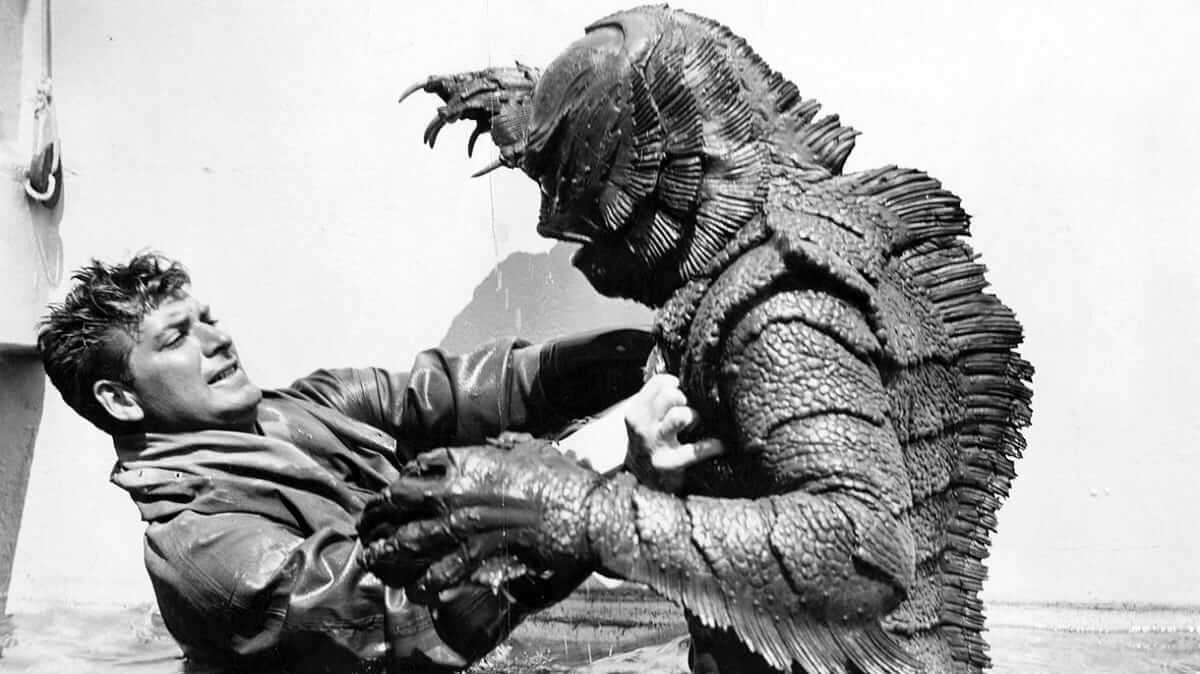
Revenge of the Creature
Times change. The era of great monsters has long passed, and now the screens are filled with bizarre variations on classic themes. Creature from the Black Lagoon / Gill-Man is the last creature with gothic roots that was truly original and developed entirely new elements within the horror genre. Without him, we would not have seen Steven Spielberg’s Jaws, millions of its clones, or films about killer piranhas, octopuses, and sharknadoes. It is worth returning to the adventures of the Monster and pondering its sad fate, for who knows if some prehistoric humanoid creature isn’t lurking in the unexplored waters of the Amazon.


LUCIA’S GRACE. Resembles a Kind Of Missionary Endeavor

DOKUMENT. Short Film That Feels Monumental

BEAUTIFUL BOY. The Acting is Remarkable [REVIEW]

Looking Back at SPIDER: More Terrifying Than Horror
