
Review
THE ONE: Is It Really All About Genetics?
Thanks to the existential perspective, The One gains enormously and one almost does not pay attention to all the science-fiction naiveties.


Genetics is a very young field of science. I would see The One as a series with high scientific probability only in 50 or even 100 years, when we will have more experience with modifying DNA. For now, there is more fiction than science in the production, which sometimes makes its script rely too heavily on generalities, for example by defining love either as an unexplored spiritual activity that escapes the the scrutiny, or as a chemical and temporal reaction of the brain to an external stimulus, aimed at replicating the genome – making children.
So if someone is in the mood for a large dose of scientific truisms, a bit of melodrama, a crime plot, a pinch of sci-fi, all of it garnished with quite wise humanistic conclusions, they should turn on Netflix as soon as possible. I will not reveal anything important by saying that the main theme of the series is genetic love matching. In the near future, two scientists, while studying genetic mutations in ants, come up with the idea, or rather discover, the possibility of genetically matching people so that they form perfect relationships. De facto, then, the vast majority of us somewhere in the world has a person who will be the perfect partner and will never leave us.
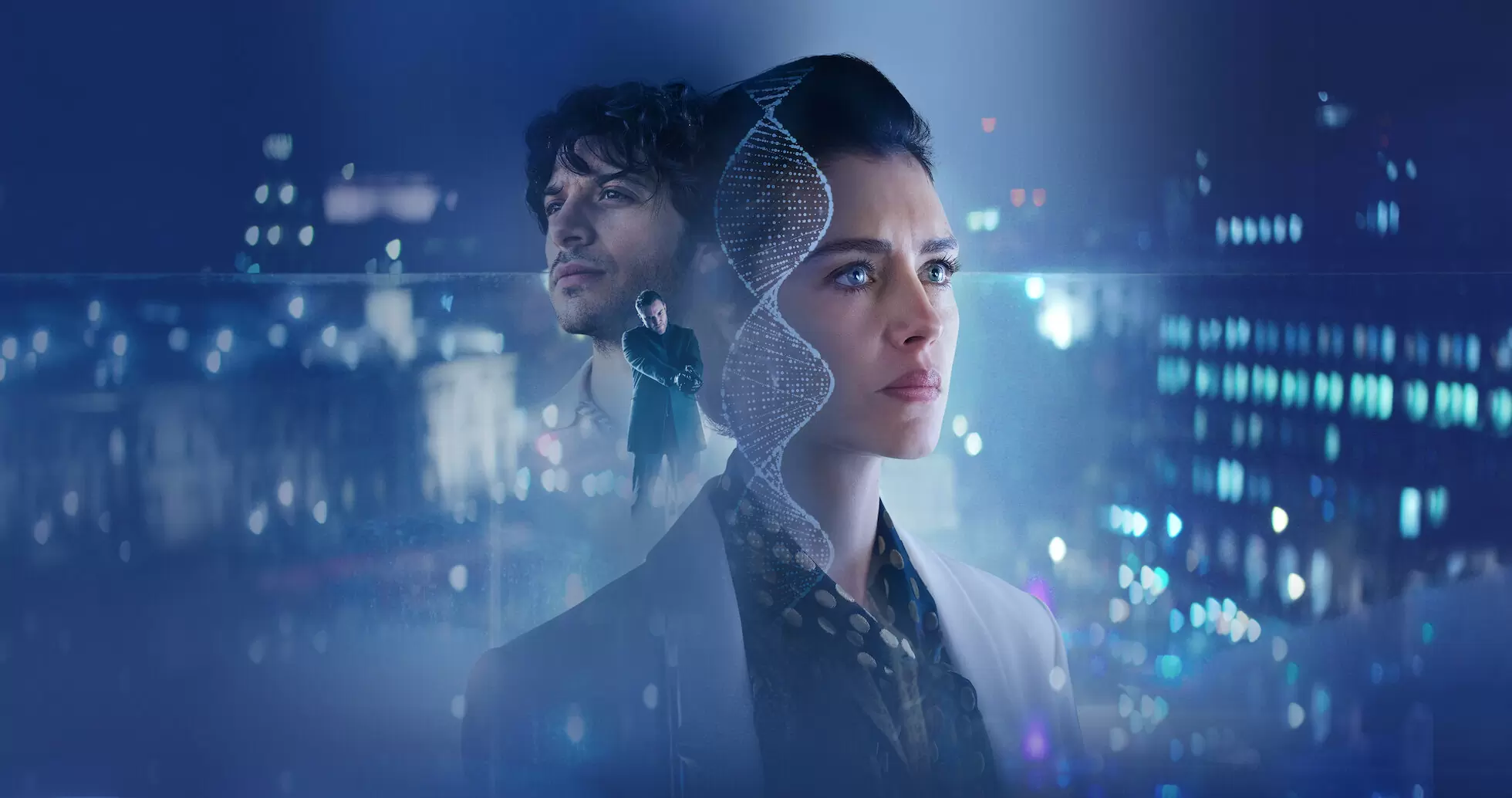
It sounds like a fairy tale dreamed by naive princesses who have spent their whole lives locked in a tower and know nothing about the world. In practice, such a discovery meant that many already established relationships, including those considered successful, were subjected to an unfair test. People were given a pairing tool, the so-called test, with which they could find out who their ideal partner was. In most cases, this meant receiving information about someone completely different from the person currently residing in their domestic bliss and who had seemed perfect.
So a social revolution was not hard to come by. In fact, one did happen. Even successful relationships experienced a kind of doubt, uncertainty, even crisis. Human beings are naturally curious, and when they find out that they can verify whether the state they are in is true or false, they will eventually take advantage of it. At first, they will think that whatever the answer, they will change nothing in their lives, but the way our mind and psyche operate is based on facts, not assumptions. The feeling that one lives in an imagined reality, while somewhere out there there is a reality depicting happiness, will never let one rest and will eventually shatter present life.

This is the main humanistic and at the same time best designed interpretive perspective of The One. People need to feel appreciated not partially, but totally, radically. They will take any opportunity to at least taste that ecstatic sensation. This is perfectly normal and not a flaw. Thanks to this existential perspective, the series gains enormously and one almost does not pay attention to all the science-fiction naiveties – and other flaws, of which there are many.
First of all, the inconsistent image of the antagonist, who is as if two people. We meet Rebecca (Hannah Ware) at the very beginning as a gloomy, evil being focused on earning astronomical sums of money from genetic pairing research. Throughout the film we are accompanied by flashbacks showing how Rebecca and James (Dimitri Leonidas) came to their discovery and why the conflict between them and Ben (Amir El-Masry) broke out. It is against this background that the entire inauthenticity of Rebecca’s character is visible, but not as the head of a company, or indeed a mafia, but as a scientist.

The personality conversion of the main antagonist is absolutely unconvincing, and the flashback threads only disturb the course of the criminal plot. In addition, the intrigue’s finale may give the impression that the creators had no idea until the penultimate episode how to end the whole story. The production mixes threads of several couples. The policewoman conducting the investigation finds her soulmate in a woman who, just before they met, has an accident and falls into a coma. The wife of a journalist secretly gives him the test for a soulmate, and then desperately tries to prevent any contact with the potential chosen one.
Life, however, goes its own way. Generally, despite the series including various equality gestures, one may get the impression that genetic matching affects mainly women. Most of them freak out at the thought that they may not be soulmates of their partners, as if finding a man were the end of the world. This is not a feminist approach, and one may get the impression that the production strikes liberal tones. The cast is multiethnic, and the relationships between the characters equally treat the value of hetero- and homosexual sex. Deep down, however, The One remains a very conservative film.
It reduces the female world to fear of losing a partner, because as is generally known – single women cannot cope in societies.

Another accusation against The One is the unevenness of its action. Flashbacks are mixed with the crime intrigue, and that in turn with typically dramatic threads, which are again based on a science-fiction idea.
The tension sometimes grows so much that one cannot wait for the resolution of the situation, only to suddenly see, for example, Hannah (the journalist’s wife mentioned earlier) waking up alone in bed and looking for her offended husband after the evening’s quarrel.
The behavior of the main antagonist is also sometimes puzzling and surprising. Supposedly she is capable of anything, yet not entirely. The same goes for her bodyguard. They have scruples all the time. In the long run, their lack of engagement in evil is really tiresome. This is not about the advantage of being multidimensional or the disadvantage of being one-dimensional. Somewhere around the sixth episode, Rebecca’s character becomes boring. Her facial expressions are as uniform as a marble statue, and the intrigue is too obvious, with no twists.

It is different with the police officers conducting the case, but I will not spoil. I will only signal that I do not quite understand the attitude of one of them.
I take it as a flaw in the script. There remains the mysterious man standing in front of the headquarters of the company specializing in genetic matching, who is also significant, which in fact is easy to guess from the very beginning.
Visually it is average, a bit too dark, with little contrast, without flair when it comes to cinematography, monotonous in sound, generally correct, but it is the correctness of the last grade of school, generated with great fear of an uncertain future, so without any experiments. That is why I took the humanistic conclusions to heart, I remembered them, but I will not wait for a second season.


LUCIA’S GRACE. Resembles a Kind Of Missionary Endeavor

DOKUMENT. Short Film That Feels Monumental

BEAUTIFUL BOY. The Acting is Remarkable [REVIEW]

Looking Back at SPIDER: More Terrifying Than Horror
