
Review
INTO THE NIGHT: Jacek Dukaj’s Prose Deserves More Than This
Into the Night is not the dreamed-of adaptation of Dukaj’s prose. The writer deserves much more; his artistic thought reaches far beyond uncomplicated tales.


Undoubtedly many fans of Jacek Dukaj’s prose were eagerly awaiting the premiere of the series based on The Old Axolotl. Additionally, the information about Tomasz Baginski as producer inspired optimism. Life, however, quickly verified these hopes; keeping fingers crossed did not help. The Polish writer’s novel was so gutted that any further comparisons of the two titles make no sense. Into the Night.
The Netflix production is a six-episode story about a world in which, under unexplained circumstances, sunlight suddenly begins to kill all humanity.
Only by a coincidence is a small group of protagonists instructed by a soldier that danger is approaching and that they must flee the coming day. A handful of people, despite initial objections, board an airplane and fly around the world merely to remain always on that side of the planet where darkness currently prevails.

The Belgian production is not any philosophical treatise, prophetic vision, attempt to predict the future, or essay on the complications connected with transferring human consciousness to another world. There is no trace of Dukaj’s thought in the series; his name appears only in the capacity of consultant. There is only a very clumsily executed, classical tale about people fleeing the apocalypse. As usually happens, the protagonists are shut up in a small, cramped space, so they must struggle with claustrophobia as well as with the quarrels that erupt among them one after another.
Viewers are given the typical assortment of protagonists differing in race and social class. The airplane in which they flee is like society in a nutshell, where apparent sympathy is founded on intolerance, hatred, and stereotypical thinking. At the conceptual level Into the Night resembles Snowpiercer, which, incidentally, Netflix produced as series too.

Some will certainly also notice certain plot similarities between the Belgian offering and the cult Lost. In the streaming giant’s title there likewise appears a series of flashbacks by means of which the screenwriters attempt to present the characters’ personalities, the motivations that drive them, and also the reasons responsible for their having chosen that particular airplane for their journey.
All of this, however, is done mechanically. The details offered have no significance. What is the point of the information that, before takeoff, one of the men was deceived by a woman on the internet, if it has no effect on his character? There are many more such oddities in this production. Apart from the flight from the sun, most subsequent problems are forced by the creators, because, after all, something has to happen.

Incidentally, this is decidedly the series’ most serious ailment. There was a clumsy attempt to deepen the characters’ psychological portraits; philosophical matters were relegated to the background already at the stage of writing the script, and thus in the end a monotonous action piece was created in which it is only about the protagonists’ survival. Quarrel on board, solution to the problem, landing, searching for supplies, flight again—and so on in a loop throughout the season.
Of course, it may be that the first season, a mere six episodes, is only a prelude, an introduction to the real game. Let it be so, because at this moment Into the Night is a completely superfluous production that does not guarantee even ordinary viewing fun. The Polish context has no significance here. It is indeed pleasant to read Polish actors’ names in the end credits, in this case Ksawery Szlenkier and someone else; the development of Baginski’s career is pleasing, but even so there is no reason to stubbornly put on white-and-red glasses.
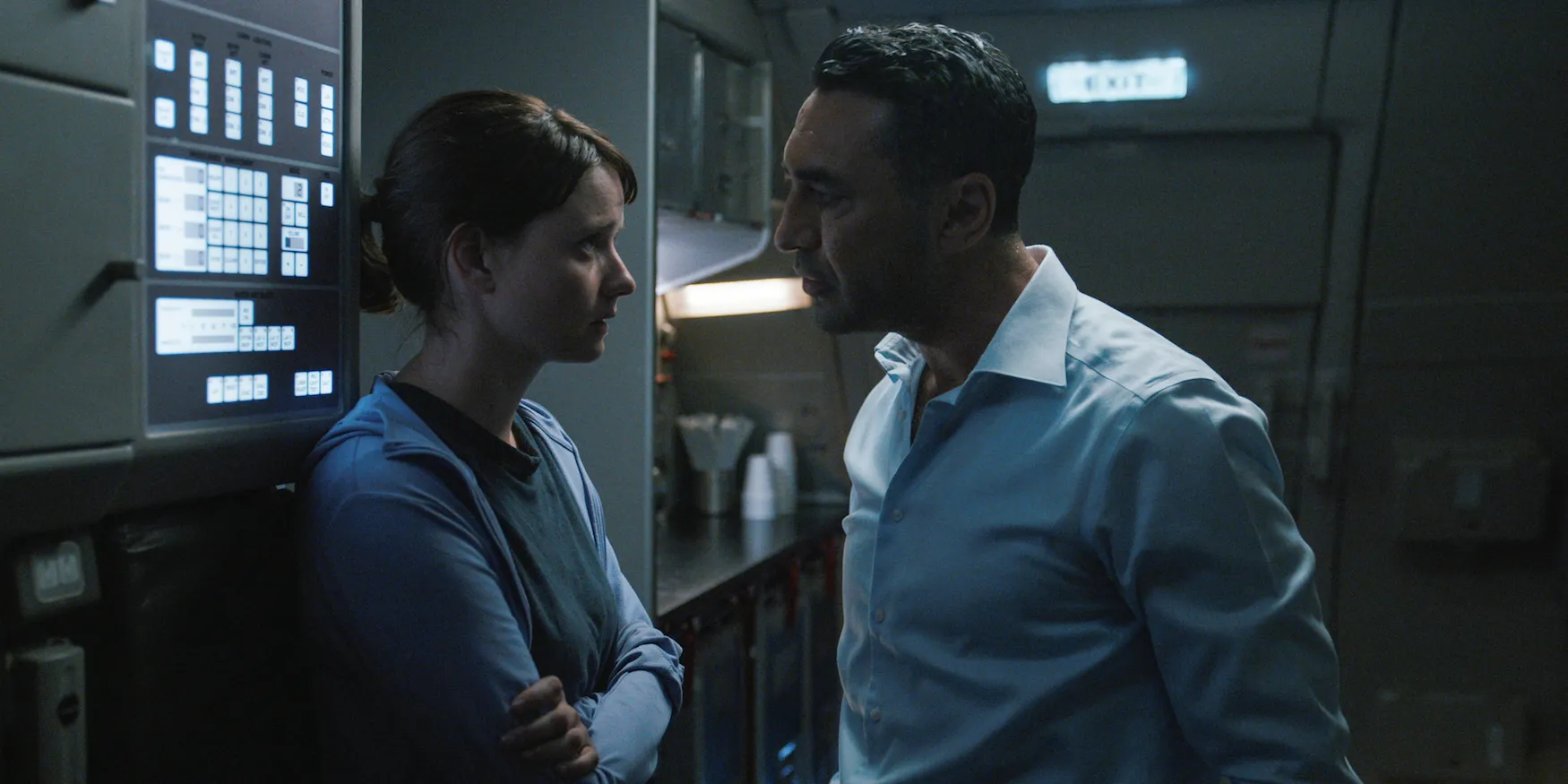
The small budget likewise should not be a mitigating circumstance. Everything here is at a rather low level; the actors are unable to summon anything more from themselves; the only plus may be the very manner of operating the camera. As Baginski mentioned in one of the reports, the airplane fuselage built for the series was specially narrowed to obtain a sense of being wedged in. The turbulence is also produced mechanically rather than processed later by computer, which creates an appearance of reality.
There is no hiding it: Into the Night is not the dreamed-of adaptation of Jacek Dukaj’s prose. The writer deserves much more; his artistic thought reaches far beyond the creation of uncomplicated tales about people fleeing murderous rays of sunlight. As for the series itself, perhaps its creators will get a chance to make a second season, but if that happens, the entire concept will have to be rebuilt. Such derivative work cannot be served up to people a second time.


LUCIA’S GRACE. Resembles a Kind Of Missionary Endeavor

DOKUMENT. Short Film That Feels Monumental

BEAUTIFUL BOY. The Acting is Remarkable [REVIEW]

Looking Back at SPIDER: More Terrifying Than Horror
