
Review
THE ENGLISH GAME: They Don’t Make Them Like That Any More
The English Game: matches, rivalry, and in the end friendship across divisions—are these not precisely the kinds of productions we seek in difficult times?


Contemporary football is associated with billions of euros earned by players, sponsors, and also officials. Sport is one of the greatest global businesses, but also a lifeline for talented children who, without boots and a ball, would not be able to break out of poverty. Julian Fellowes, the creator of Downton Abbey, reaches back to the roots of the most popular discipline in order to understand on what foundations the phenomenon that viewers are currently dealing with was built. The English Game.
The English Game is a six-episode series about pioneers taking their first steps in football.
Up to the moment when the action begins, this sport is reserved mainly for noble gentlemen who, for pleasure, take off their hats and jackets in order to have some fun with this discipline. Although there are official competitions and one can even win a cup, this way of spending free time is still treated only as unpaid entertainment. No one receives a salary, no one is a professional, there are no club structures, and the members of the association who set the regulations are the players themselves.

It is precisely under these conditions that Fergus Suter (Kevin Guthrie) has to operate, who, together with his friend Jimmy (James Harkness), is to change the face of the Darwen club.
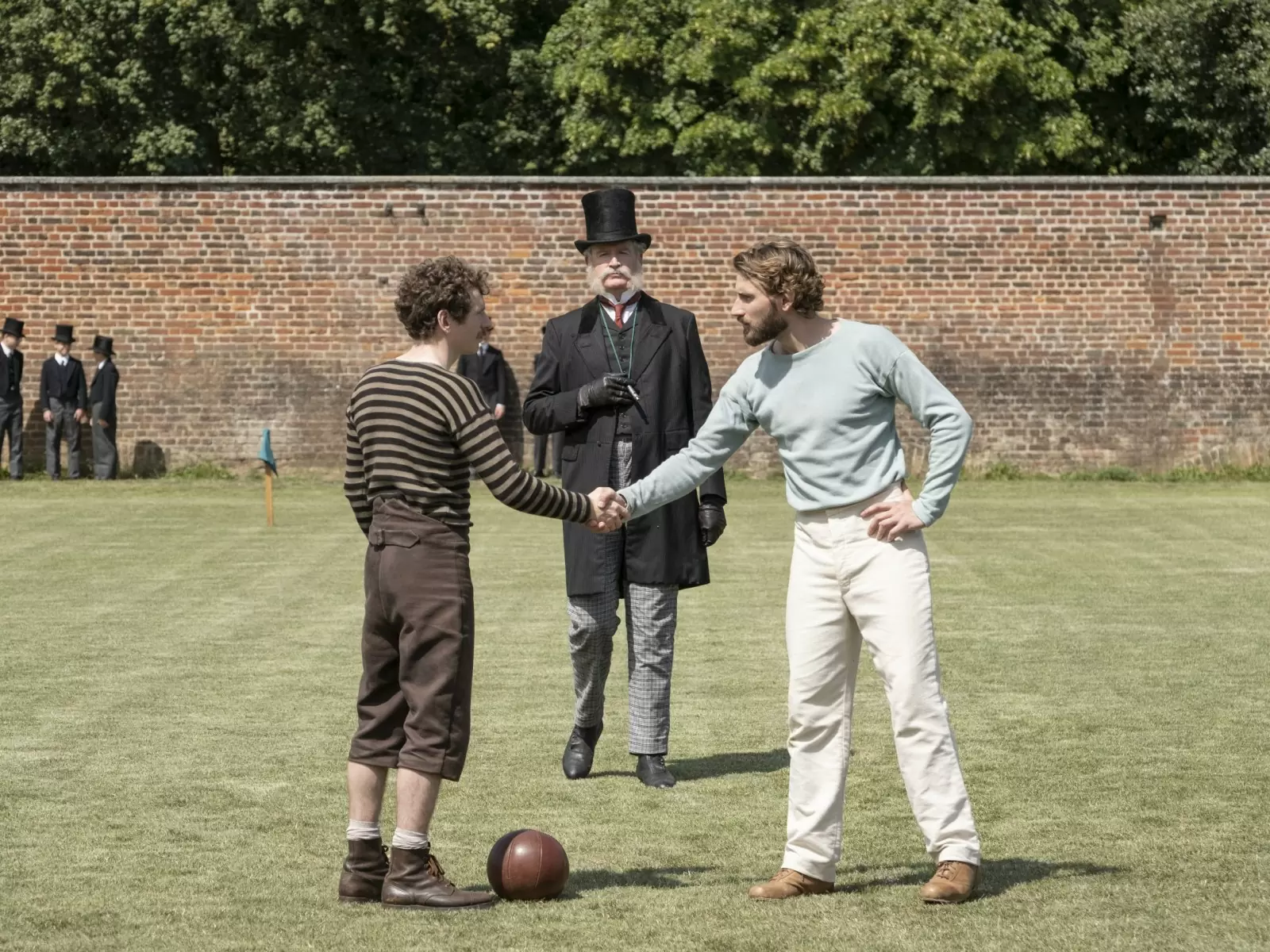
The owner of the team composed of workers breaks the regulations by paying two talented players for their appearances, just to finally break the primacy of the aristocratic teams, especially the Old Etonians. Fellowes reaches for archival events, embellishing them in his characteristic manner, in order to present yet another class skirmish, this time against the backdrop of football.
It must be said plainly—such series as The English Game are essentially no longer made. The creator of Downton Abbey once again creates a world as if from another reality. Although he clearly points to all the tensions between workers and the aristocracy and does not hesitate to highlight the causes of the exploitation of the poorer strata of society, the protagonists he depicts are nonetheless made of completely different clay.

The owner of a small factory is a modest man who cares about the well-being of his employees, representatives of the lowest social class are noble people who only sometimes go astray, and even among the richest there are honorable citizens ready to renounce laurels so that justice may triumph. Although The English Game does not lack difficult topics, the world presented is idealized. From the outset it is known that good will win, truth will triumph, warring classes will be reconciled thanks to football, and wounded lovers will ultimately join in a loving embrace.
However, this should not be regarded as a flaw. It seems that many viewers have become accustomed to depicting evil as the inviolable foundation of reality, yet Fellowes reminds us with his sugar-coated picture that there is something more important than money and a deviously understood honor. Sometimes it may be love, sometimes a passion for sport, but it is certainly about higher values thanks to which all differences between people disappear.

Although Fellowes tells yet another story about social tensions, he does not forget the most important element of the series. In each episode football matches are shown, which one watches with childlike pleasure. The Netflix offering allows one to go back in time in order to watch sporting spectacles devoid of marketing trappings. In these scenes the phenomenon of sport is effectively captured, in which the poor can defeat the rich, and beyond the competition itself something more counts, for example belonging to club colors and representing the local community.
At the same time, in the context presented, money does not at all deprive this discipline of innocence, but is merely a guarantee of professionalization and a leveling of opportunities among participants. This is understood especially by Arthur Kinnaird (Edward Holcroft), perhaps the most interesting character in the entire series. The man undergoes a transformation from a self-important boy wrestling with complexes to a mature sportsman. And the fact that, in the process, he warms his relationship with his absent father and wins back the heart of his lonely wife only further proves that there are no problems that cannot be solved.
Although there are historiographic elements in the plot of The English Game, the Netflix series is nonetheless a lovely tale of a world that never was. In spite of this, it is worth entering it and allowing oneself to be carried away by a charming story about people who are able to sacrifice literally everything in the struggle to realize their dreams. Matches, rivalry, and in the end friendship across divisions—are these not precisely the kinds of productions we seek in difficult times?


LUCIA’S GRACE. Resembles a Kind Of Missionary Endeavor

DOKUMENT. Short Film That Feels Monumental

BEAUTIFUL BOY. The Acting is Remarkable [REVIEW]

Looking Back at SPIDER: More Terrifying Than Horror
