
Article
8½: Federico Fellini’s Seminal Masterpiece Deciphered
The poetic force, which erupts in Fellini’s opus magnum, 8½, was dormant within the artist from the very beginning, gradually awakening from this long slumber..


…– and which remained in the works of this screen magician until his death, was dormant within the artist from the very beginning, gradually awakening from this long slumber and subtly revealing itself in his early films, unobtrusive to our attention.
One might assume that, like any debuting creator, Fellini was searching for his style – his unique “stroke,” which he learned and perfected in his early works – realistic and seemingly devoid of poeticism. However, there is another aspect of this situation – Italian neorealism, which had been developing since the end of World War II and constantly influenced the master, in a sense restraining his lyrical inclinations. Nevertheless, Fellini’s entire body of work (despite the radical stylistic change in 8½) is decidedly personal and authorial; and the departure from realism should be attributed more to the internal development of the artist than to a liberation from the prevailing trend, whose decline we observe in the second half of the 1950s.
Therefore, we can confidently encompass the works of the La Strada author with a single frame and sign it with his name.

Evidence? In every Fellini film after 8½, which marks a clear division in his filmography, we can see elements of the style whose seeds are found in his early works (speaking of early works, I mean films made before 1963). One such element of Fellini’s authorial idiom is the autobiographical nature of his works. Federico Fellini populates his worlds with characters created based on real people. Their silhouettes lingered in the director’s memory, leaving their mark on his consciousness. An example here is Saraghina, a local prostitute from Rimini, whom the director recalled in Otto e mezzo. However, apart from the recurring motifs in Fellini’s works, such as the fondness for bizarre characters, recurring landscapes (very often the beach), the broadly described phenomenon of vitellonism (emotional and social immaturity), and the significant scenes following “orgiastic” sequences (I Vitelloni, La Dolce Vita), I will return to the issue of poeticism, which I believe is a kind of key to the author’s style of the screen magician.
In my opinion, poetry (or “screen poetry”) is a very vague and unclear concept – something inherently not so much indefinable as extremely resistant to rigid and clumsy words of definition. However, feeling obliged to attempt to outline this term, I will quote Mirosława Salska-Kaca, who in the article Selected Problems of the Style of Poetic Film defines the phenomenon as follows:
[…] The poetic film, instituted by the lyrical function, is generally characterized by the evocative nature of the depicted reality, the metaphorical construction of the narrative, aiming to stimulate the viewer’s associations; particularly important in this statement is the emotive and autotelic function […].

Thus, when dealing with a poetic film, we encounter a certain additional organization of the filmic text. Simply put – a certain depth of meanings. For example: in the final scene of La Dolce Vita, the main character – Marcello (played by Marcello Mastroianni) – is unable to hear the call of a girl standing nearby. She is drowned out by the sea waves. At first glance, the scene is understandable. However, upon closer inspection, we notice elements that hide meanings and demand interpretation.
How to recognize such an additional construction of the scene? The first clue is the grotesqueness of the whole situation. The distance between the characters is small. Just a few steps would be enough for the characters to communicate with each other. Instead, Marcello kneels in resignation on the sand while the girl unsuccessfully tries to shout over the noise on the beach. Of course, this brilliant scene should be interpreted in the context of the whole film and all the information we gathered during the screening. Thus, the girl on the beach can be interpreted as a symbol of a certain kind of “purity” that Marcello longs for – as the opposite of the corruption that Rome in the film is teeming with (You know, you look like an angel from Umbrian stained glass windows? – asks the main character in the restaurant scene). One could say that she belongs to the world of ideas, which the protagonist cannot access due to the hedonistic lifestyle he leads.

Much can be written about the symbolism of the sea in Fellini’s works. In many films, it represents a chance for rebirth (as in the ending of La Strada). It is similar in La Dolce Vita. The final scene by the sea gives the hero a last chance for redemption, which he does not take. He remains deaf to the voice of his angel and, as usual with Fellini, the film ends with a lenient conclusion – the girl’s benevolent smile. There are, of course, more subtle examples of poeticism in films before 8½. I could mention, for example, the symbolic characters from La Strada, which Maria Kornatowska writes about:
[…] Without falling into the exaggeration typical of Fellini’s exegetes, one can assume that the three characters of the film represent three fundamental elements of human existence for the director: sensual corporeality, which confines a person within the limits of their biology and material needs (Zampano); the spiritual element, which constitutes the bond between a person and the world and other people, in contrast to the body, it connects rather than divides (Gelsomina); and fantasy and freedom, which is often the domain of art and dreams (The Fool) […].

The episodic structure of the film (e.g., I Vitelloni, La Dolce Vita in early works, 8½, Satyricon, Roma, Amarcord, City of Women, etc. in mature works), which focuses on descriptiveness, diminishing the importance of the story itself, also fosters poeticism. The emotive function, mentioned by Salska-Kaca, is clearly evident here, as the camera’s eye is set on the contemplation of the presented reality, thereby evoking emotions in the viewer.
Federico Fellini before 8½ is an artist torn between realism and fanciful poeticism.
In the 1950s, there was no director in Italy who did not succumb to the influences of Neorealism, as Kornatowska writes:
[…] Neorealism, as a sum of certain searches and experiences, completely transformed Italian cinema, and in this sense, every Italian filmmaker had to find himself within its sphere of influence […].

On the one hand, his films before 1963 are realistic; on the other, we find metaphors and a remarkable fascination with the world of ideals and dreams. Indeed, the obsessive desire to escape into the realm of dreams characterizes all the early films of the master.
Wanda (Brunella Bovo) from The White Sheik – Fellini’s Madame Bovary – is a newlywed housewife, engrossed in cheap romance novels and dreaming of great, ideal love. The titular loafers from the 1953 film daydream about grand plans of escaping the province. Gelsomina (Giulietta Masina) from La Strada vainly seeks warmth in another person, while Augusto (Broderick Crawford) from Il Bidone, subconsciously or not, longs for redemption. The cheap journalist Marcello from La Dolce Vita wants to break free from the clutches of empty existence, seeking inspiration and a stimulus, but when he finds them, he remains deaf to their call.
However, reality is not kind to Fellini – it pulls the director down to earth along with the crowd of his characters. Wanda will learn that fairy-tale princes do not exist and will return to her husband; the loafers will likely end their days in the province (except for the youngest, Moraldo); and Gelsomina and Augusto will die in loneliness and oblivion.

All these works are permeated by the same motif of longing and disappointment – the same one that seemingly haunted the director’s life. Just as his characters long and dream, Fellini longs for the extraordinary and poetry. His thoughts revolve around transcendent ideals, yet something always pulls him down to earth. Whatever it may be: the film environment steeped in the poetics of Neorealism, Italian criticism, or an inner immaturity for radical changes – it gives the impression of some artistic blockage.
Therefore, in terms of form, I believe that during this period of his activity, Fellini, consciously or not, compromises with the audience and employs half-measures. Only in 8½ do the poetic tones pour out of the director as if he finally broke the barrier that had weighed him down from the very beginning and gradually subsided film after film. The very first sequence of the main character’s dream – Guido Anselmi (Marcello Mastroianni) – is a kind of summary of the director’s struggles from previous films. Guido Anselmi is trapped in a traffic jam, suffocating in his car, just as Fellini suffocates in his environment. When he finally manages to get out of the car, he soars into the sky and flies away – free as a bird.
However, shortly after, someone (again on the beach!) throws a lasso around his leg and pulls him down to earth. Interestingly, that someone will be one of the journalists appearing in the final scene…
8½ of the Film
The 1960s were an extraordinary period for cinematography. Ingmar Bergman produced a series of masterpieces, the French New Wave emerged, challenging Hollywood’s “cinema of the fathers,” and in Italy, Michelangelo Antonioni presented his famous tetralogy (L’Avventura, La Notte, L’Eclisse, Red Desert). During this time, Federico Fellini broke away from neorealistic mimesis once and for all with the creation of 8½.

Otto e mezzo is undoubtedly a groundbreaking work, one of the greatest masterpieces in the history of cinema. Why? Primarily because it was unprecedented for its time in its exploration of the protagonist’s psychological state. The film combines a multi-layered structure of meanings with an incredible portrayal of the inner life of the main character. Fellini’s work defies all the storytelling rules established by American screenwriters. The plot here is treated as a pretext for descriptive richness. The director seems interested solely in the psyche of Guido Anselmi—Fellini’s alter ego—which is thoroughly explored in the film.
Guido Anselmi is a director staying at a health resort to recover from exhaustion.
His drama lies in the fact that he is in the process of making a new film while experiencing a profound creative crisis:
I assumed that all my thoughts were organized. I wanted to make an honest film, without any lies. I thought I had something very simple to say. A film that could be useful to everyone, that could bury what is dead within us. Instead, I am the only one who lacks the courage to bury anything. There is chaos in my head—this tower I have here. I wonder why things have taken this turn, where I made the mistake? I have nothing to say at all, but I intend to say it nonetheless, complains Guido.
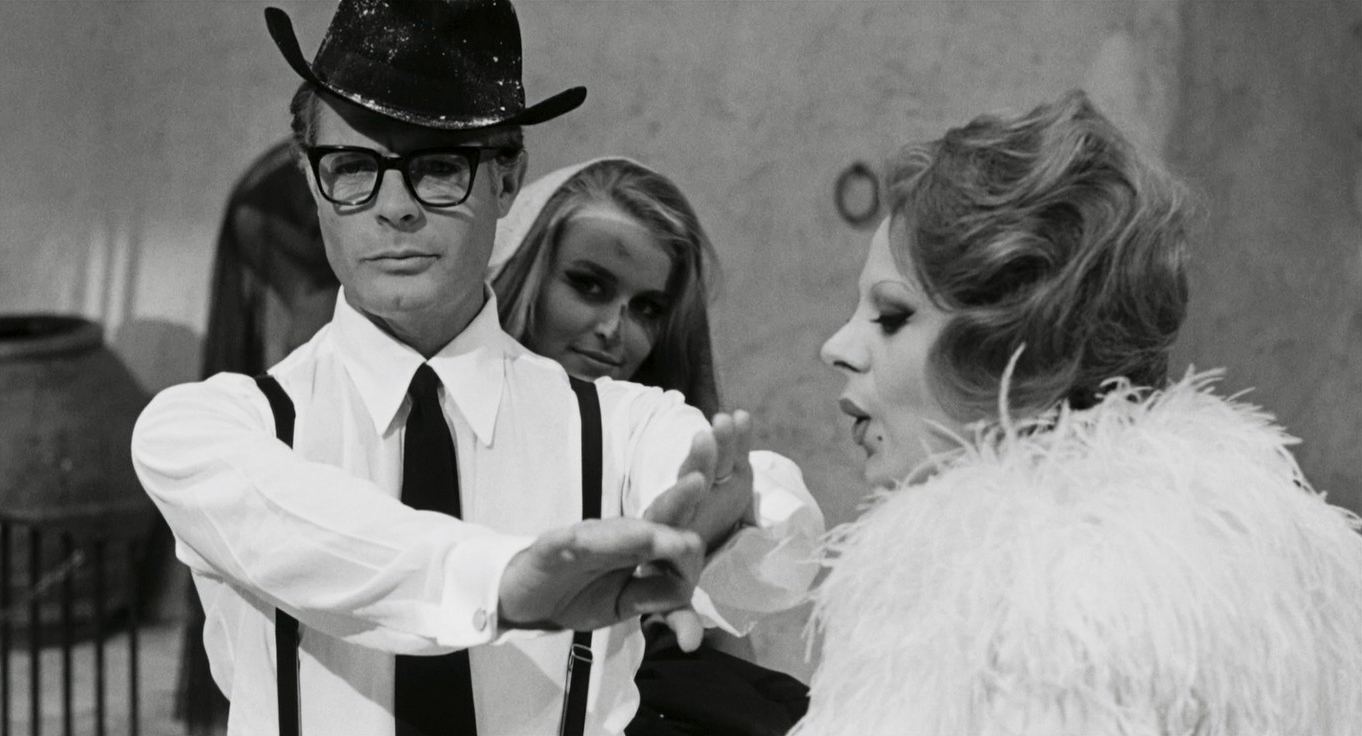
The way Federico Fellini talks about himself in the film is astounding. This is evident even from the title—before 8½, the director had made seven films and contributed two segments to anthologies. Tadeusz Miczka, in his article titled Form and Indeterminacy in Cinema: 8½ as an Open Work, cites an intriguing theory by French film theorist Christian Metz, suggesting that three levels of action can be distinguished in Fellini’s film:
1. The action of Guido’s imagined film (Guido as the hero of his film)
2. The reality in which Anselmi operates (Guido as the hero of Fellini’s film)
3.
Fellini’s artistic reality bordering on his real world (Fellini as the hero of his film)
It’s surprising that 8½ could fit into each of these segments individually and be viewed within their frameworks. For instance, we could watch Otto e mezzo as Guido Anselmi’s film, where the main character is Guido’s alter ego. We might assume this is what the film would look like if it were made. Or perhaps it has already been made and is not a science fiction film with a rocket backdrop but a “film about a film” that Guido Anselmi made, and we are watching it? One of the characters, the writer Daumier, comments on Guido’s film as if he were talking about the characters in 8½, the film he is part of:
You see, on the first reading, you notice a certain lack of ideological problems, or if you prefer—philosophical premises, which makes the film a series of unsubstantiated episodes, although quite amusing in their ambiguous realism.
Do these characters make us think? Do they want to fill us with horror?
Daumier’s statement serves as a form of self-ironic director’s commentary. We can also interpret the film traditionally, with Guido as a creation invented by Fellini, or in another way—Guido is Fellini, the director himself being the hero of his own film (indicated by numerous autobiographical elements and the protagonist’s style—hat, cape, and even manner of movement). The director’s mastery is evident in how these segments overlap without conflicting with each other. 8½ is a dream within a dream. It is simultaneously Guido’s film and Fellini’s film, which opens up to an intellectual game with the viewer.

Filmic Licentia Poetica
According to Salska-Kaca, the constitutive functions of poetic communication in film are the emotive and autotelic functions. Simply put, the most important for a poetic film are evoking emotions and clothing the film in a specific form (depending on which of these elements prevails in a given film, we divide poeticism into warm and cold). In 8½, both these elements—emotiveness and autotelicity—interact with each other, one flowing from the other and vice versa. In Fellini’s masterpiece, the emotive function is based on the internalization of the presented world (which entails form).
It can be said that this presented world is generated by the main character—it is his emanation and image of his soul. This internalization of the screen reality, assuming its deformation, conditions the emphasis on the autotelic function in the message. To convey the protagonist’s complex inner life, a specific form—highlighted and non-transparent—is needed. In the film, there is not a single scene that is not filtered through Guido’s psyche.
Narration
Thus, it would not be mistaken to say that the key to understanding the phenomenon of poeticism in 8½ and in film, in general, will be simply subjectivity. Mirosław Przylipiak, in his article “On the Subjectivization of Film Narration,” lists seven ways of conducting personal narration in film, and significantly, all of them appear in Fellini’s masterpiece.

Point of View
This technique involves creating within a few shots such spatial relationships that one—or more—shots contain the image seen from the position of a character in the diegesis, writes Przylipiak. Interestingly, from the very beginning of the film, we see the world through Guido’s eyes—from the dream sequence, through the scene after waking up, until the moment the character is in the bathroom. We do not see his face because either we are viewing reality from Guido’s point of view, or we see the back of his head, or something constantly covers his face (sheet, shadow).
Only when Mastroianni enters the bathroom and looks in the mirror do we learn what the main character looks like. It’s as if the director wants to announce right away that we won’t see anything in the film that Guido doesn’t see. That he is the intermediary through whom we will experience all events. There are many scenes in the film where the camera is guided from the protagonist’s point of view—for example, the shot in the baths when the hero goes to meet the cardinal. Various characters block his path, offering advice or asking for intervention with the church dignitary.
Internal Monologue
This second technique, which long enjoyed esteem among film theorists and for the same reason as the first, is well-suited to classifications and explanations.
Practitioners, however, treat internal monologue with suspicion. It is often believed among them that it is a less subtle and too easy technique. When there is no idea to show the character’s interior, then ineptitude, lack of imagination is patched up with internal monologue.

Fortunately, Fellini lacks no imagination, so the internal monologue is not a frequent solution in 8½. We encounter it in only a few scenes. For example, when Guido finally finds himself alone in his hotel room after a whole day, we hear from off-screen: Inspiration crisis? And if it is not temporary at all? And if it’s the ultimate downfall of a liar devoid of genius and talent? We can also consider scenes where the protagonist talks to his ghosts as a form of internal monologue.
There might be a debate about whether talking to hallucinations is a dialogue or a kind of monologue. I would lean towards the second option, as these “ghosts,” as Guido calls them, are just projections of the feverish psyche of the protagonist. It is thus a kind of conversation with oneself, a monologue or soliloquy.
Point of Hearing
[…] It is the place within the film’s world from which the sound is conveyed to the viewer […]. In one of the scenes, Guido hums a musical motif that recurs throughout the film. This is undeniable proof that we are constantly hearing the music that actually resounds in the protagonist’s mind. I feel that this technique brilliantly reflects the mechanisms of our psyche.
We often say that a song we’ve heard somewhere “follows us” and keeps ringing in our ears. In 8½, we encounter various variations of pieces by known composers (including Wagner), which sometimes overlap (e.g., pieces of rumba woven into Nino Rota’s music, first heard when Saraghina enters the scene), creating strange mixes or surprising us with an unexpected pause (as in the scene where Guido has his first vision). It is Anselmi’s psyche that controls the music in the film. We hear what is currently ringing in the protagonist’s head, reflecting his state of mind.

Freely Dependent Subjectivity
[…] These are films that give the viewer an irresistible impression of subjectivity, though they do not use any aggressive procedures.
It is known that one way to strongly saturate the film’s world with a character’s personality is simply through their sufficiently long and intense presence on screen […]”
8½ is freely dependent subjectively in the sense that there is no scene without Guido. We thus adopt the character’s horizon of information as our own. The protagonist (aside from other subjectivization techniques used in the film) is a narrator in the sense that he acts as a kind of “data filter” through which the viewer constantly perceives, allowing themselves to be drawn into the world created by Fellini.
Mental Images
[…] The effect of a mental image is almost always achieved through the deformation of the objective, with the word ‘objective’ understood to include both specifically filmic conventions that possess the status of objectivity and the viewer’s beliefs formed outside the cinema about what is possible and probable […].
Watching the Italian master’s work, we can feel that the reality depicted on screen is so distorted that it borders on a dreamlike hallucination. It is as if we are observing reality through the eyes of a dreamer or a mentally unstable person. Every element of the depicted world is a projection of Anselmi’s consciousness (or subconscious) – from the set design to the characters’ behaviors.

Starting with the set design, each scene is a mirror reflection of Guido’s mood, each is somehow spontaneously “staged” by the protagonist’s subconscious. Take the scene at the spring. The movements of the extras are unnaturally artificial, synchronous. The characters move in time with Wagner’s piece, as if they had “learned” the choreography beforehand. Finally, Guido appears – the unconscious director of this amazing spectacle. He stands in line for the watering place, looking around, bewildered by the peculiar sight. Another intriguing scene is the spa treatment, with a set design styled as ancient baths and actors as Roman citizens. The characters are wrapped in long togas, their silhouettes shrouded in thick steam.
There are many examples. The stark interiors of the Catholic school, which Guido remembers from childhood, were dubbed “Kafkaesque expressionism” by Kornatowska. An observation I find very accurate. This heavy, Kafkaesque atmosphere is palpable when the strict priests judge the boy and punish him for associating with the local prostitute. The camera work in the final scene is also interesting. Anselmi, during the press conference, talks to his “ghosts”. The camera is free, soaring over the set like the specters haunting the protagonist. As I mentioned earlier, the retinue of characters surrounding Guido is one large mental image.
Just recall the gloomy cardinal, who solemnly quotes Origen in response to the protagonist’s confession: Your Eminence, I am unhappy!. While the protagonist in his film wishes to present simple truths, to say something very straightforward – Daumier, representing the artistic conflicts tormenting the director, comments on the script in an overly intellectual and convoluted manner, continually deepening Guido’s artistic impotence.

Frame
[…] Strictly speaking, these are the boundary images, those images in a film that separate the real parts from those motivated by personality […] In contemporary cinema, clear separation of subjective from objective parts is no longer essential and is often omitted.
Nevertheless, the frame remains perhaps the most effective way of informing about the status of a sequence, whether we are dealing with a dream, a hallucination, a memory, a vision, etc. […].
Abstracting from the fact that in “8½” we cannot speak of a “subjective part” and an “objective part” since there are no objective parts in the film, the image involves these subtler types of framing. The memorable and highly lyrical scene where Guido’s deceased mother appears in his bedroom and takes him to the realm of his own dream serves as an example.
Discourse
[…] This technique realizes itself by breaking the illusion of the depicted world through a declared transformation of the film and each of its elements into a statement […].
8½ is a discourse in the sense that I have already mentioned. Primarily, it is a “film about a film”, an autotelic statement. Of course, being a “film about a film” alone is not enough to break the illusion, but if 8½ is a film about 8½, the entire depicted world is unmasked. As I indicated earlier, in one scene, Daumier comments on the characters in the film, within whose diegesis he functions as a character himself, which means his horizon of knowledge can (though it does not have to – it all depends on interpretation) even coincide with the horizon of the audience’s knowledge. In such a situation, the boundary between characters and the audience becomes blurred, and the created illusion on screen shatters, simultaneously expanding its interpretive potential.

Based on Przylipiak’s theory, it can be proven that 8½ is subjective in every respect, as it employs all the above techniques.
Why is this subjectivity so crucial for poetic communication? Poetry is a kind of reflection. A personal reflection, an intimate confession of the lyrical subject. Everything we read in a poem is filtered through the sensitivity of this supreme “I”, which speaks through the poetic message. This is why subjectivity and individuality are essential here. It is the same in film. The more personal the director’s message – the more subjective the screen vision will be. Let’s return once again to the two primary functions of poetic communication mentioned by Salska-Kaca.
It is this broadly understood subjectivity that gives rise to both. The filmmaker-poet’s message will be intensely personal, and therefore full of strong emotions (the emotive function). On the other hand, subjective perception of reality will create a subjective form – one that will deeply shake the viewer and not allow them to forget it during the screening (the autotelic function). Of course, practicing screen poetry gives the director a much broader scope of creative freedom than the prosaic film material. This is why the first sequence of 8½ best illustrates the emotional state Fellini was in at that time – the artist wants to be free, to float in the clouds, though he realizes that in the case of film direction, this is extremely difficult.

Federico Fellini – the Cursed Poet?
It is surprising how the film subtly hints at comparing Guido (most likely Fellini himself) to Arthur Rimbaud. In one of the final scenes, Daumier says:
We suffocate with words, images, and sounds that shouldn’t even exist, that come from the void and aim for the void. From artists worthy of this profession, we expect only one thing – an act of loyalty. To learn to be silent. Do you remember Rimbaud’s work?
The finale of 8½ offers us two remedies for creative impotence, both associated with the figure of Rimbaud.
The first is silence. The artist should not “intensify this chaos,” as Daumier says, referring to the worthless, “miscarried” creations that can come from a burnt-out artist. Only a great poet can fall silent when there is nothing more to say. Just as Rimbaud did in 1875 after writing Illuminations. The second remedy is the cult of primitivism, symbolized in the film’s finale by the circus parade, consisting of all the characters from 8½ – both those from the present timeline and those from memories, dreams, and visions. At one point, Guido himself becomes part of this fantastic procession, choosing primal simplicity (film art originated from the circus). This cult of primitivism accompanied Rimbaud throughout his life, leaving its mark on his work. It is evident in such works as My Bohemia or The Drunken Boat.

This aspect is also visible in Fellini’s work, who (like Rimbaud) views the world with the disarming honesty of a small child. Fellini never judges. He is an attentive observer – exposing human behaviors and passions that torment every soul, yet simultaneously aware that they are one aspect of humanity – the animalistic and primal one (most clearly seen in the example of Marcello from La Dolce Vita or young Guido and his artificially repressed fascination with Saraghina). In Agnieszka Holland’s Total Eclipse, Rimbaud (Leonardo DiCaprio) says something that perfectly captures the philosophy of the French poet’s life:
I realized that to become the greatest poet of this age, I must experience everything.
It was no longer enough for me to be just one person. I decided I would be everyone.
It is astonishing that Guido, in one of the final scenes, says something quite similar:
No, this hero (meaning Guido=Fellini) is not capable of this. He wants to have everything, to give up nothing. He changes his desires every day because he fears he might miss the right one and dies of exhaustion.


LUCIA’S GRACE. Resembles a Kind Of Missionary Endeavor

DOKUMENT. Short Film That Feels Monumental

BEAUTIFUL BOY. The Acting is Remarkable [REVIEW]

Looking Back at SPIDER: More Terrifying Than Horror
